Mao Zedong Quotes
The Long March The Red Army is not afraid of hardship on the march, the long march. Ten thousand waters and a thousand mountains are nothing. The Five Sierras meander like small waves, the summits of Wumeng pour on the plain like balls of clay. Cliffs under clouds are warm and washed below by the River Gold Sand. Iron chains are cold, reaching over the Tatu River. The far snows of Minshan only make us happy and when the army pushes through, we all laugh. October 1935
Mao, Zedong. "The Long March." Poems, Foreign Languages Press, 1976, p. 17.


Many American ideologues assumed that the Chinese Communist Revolution would lead to an economic collapse. They did not realize that historically a competitive business economic system had been operational in the Chinese culture for thousands of years. In reality the economy was however really being suppressed somewhat by the Mau style of communism. When Deng loosened up the economic rules in China, their “Communist” system not only functioned as it had under Mao, but then thrived and China became a world economic power in just a relatively few years.


Martha Jane Canary. When she was a scout for the army she had gotten into and out of so many scrapes that Captain Egan named her “Calamity Jane, the heroine of the plains.” The name stuck. This was the kind of adventure that accounted for her nickname.

Chaing Kai Chek seemed to have the Red Army on the run with far more guns, planes & men. However while Chaing thought he was chasing the Communists, the Red Army traveled through 11 major Chinese provinces, helping the peasants to harvest their crops, build their homes, care for their sick & get indoctrinated in Communist political philosophy. In comparison, the Chaing forces abused the peasants, corruptly stole from them & brought no improvement in their living standard, sense of hope or fairness. Massive retreat became massive victory as so much of China had a Chance to compare the communists with the Kuomintang & unfortunately chose communism as Chaing and the Kuomingtang was such a poor example of capitalism-corrupt, ineffectual and heartless. At the same time, Mao and the other communist leaders were brilliant in their use of the retreating army to improve the lot of the peasants and left their biggest supporters as they were driven to the next province and repeated the process.

The early revolutionary Chinese Communists had a much more democratic and civil-liberties oriented view of government than after the had won and gained control of China. Then the problems were so enormous with such meager resources that the insecurity of the party government let to a civil rights flip flop and a politically authoritarian government. Stability is today the most important priority for the Chinese Communist party so that free speech, protests and other civil liberties are curtailed. Economic development is the more important activity and political development is lagging, but while economic development is racing ahead, Chinese political development improves only slowly. Dissidents like Liu Xiaobo are pushing the process.
This was a fairly unique notion. In Russia the army never played this role to the same degree. The Long March in Chinese History blended and amalgamated the people and the army in a way that was unique in World History.


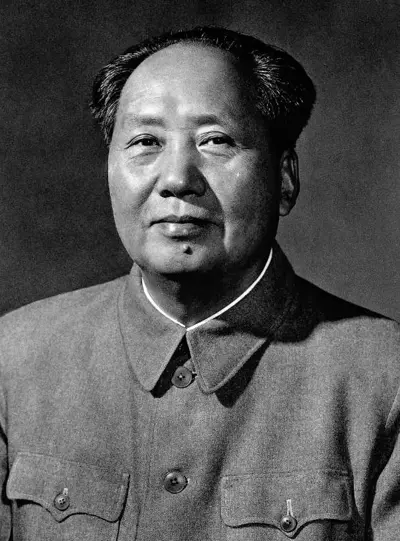
Mao Zedong, also known as Chairman Mao, was a Chinese communist revolutionary who was the founder of the People's Republic of China (PRC), which he ruled as the chairman of the Chinese Communist Party from its establishment in 1949 until his death in 1976. Ideologically a Marxist–Leninist, his theories, military strategies, and political policies are collectively known as Maoism.
