Leon Trotsky Quotes
In 1925 - 27 the revolution in China was destroyed by the false revolutionary strategy of the Stalinist faction. To this last question I consecrate my book, Problems of the Chinese Revolution (issued by the Pioneer Publishers, New York 1932).
Trotsky, Leon. "Answers to the Questions of the Chicago Daily News." Writings of Leon Trotsky (1932), Pathfinder Press, 1973, p. 166.


Many American ideologues assumed that the Chinese Communist Revolution would lead to an economic collapse. They did not realize that historically a competitive business economic system had been operational in the Chinese culture for thousands of years. In reality the economy was however really being suppressed somewhat by the Mau style of communism. When Deng loosened up the economic rules in China, their “Communist” system not only functioned as it had under Mao, but then thrived and China became a world economic power in just a relatively few years.


The Communists under Mao won the Civil War easily as the Nationalists were not only corrupt and very unpopular, but they were not very interested in the welfare of the Chinese peasants. Further Chiang was a ruthless dictator. At the time there was great pressure for America to support any faction that was anti Communist regardless of how bad they were themselves. Davies and others who thought that we should have communications with the Communists who would soon control China, were viciously attacked by Senator McCarthy who accused Davies of “loosing China” and the Senator and some other Americans thought that the Nationalists could win the Civil War. We now know that they never had a chance, but at the time they did a very good job of promoting their cause and capability in the United States and especially in Washington. None the less, in the Red Scare, Davies was fired, only to thereafter be awarded the highest civilian award in the nation in recognition of his great and patriotic work.

It was Mao whose brilliant leadership defeated Chiang and forced him give up China and flee to Taiwan. It was not Mao’s military ability, but his understanding of the Chinese people and how to lead and motivate them that enabled him to be victorious. Chiang, the better general and military tactician, was a strategic failure and his only experience with the average Chinese person was to rule, intimidate and command him.


Chaing Kai Chek seemed to have the Red Army on the run with far more guns, planes & men. However while Chaing thought he was chasing the Communists, the Red Army traveled through 11 major Chinese provinces, helping the peasants to harvest their crops, build their homes, care for their sick & get indoctrinated in Communist political philosophy. In comparison, the Chaing forces abused the peasants, corruptly stole from them & brought no improvement in their living standard, sense of hope or fairness. Massive retreat became massive victory as so much of China had a Chance to compare the communists with the Kuomintang & unfortunately chose communism as Chaing and the Kuomingtang was such a poor example of capitalism-corrupt, ineffectual and heartless. At the same time, Mao and the other communist leaders were brilliant in their use of the retreating army to improve the lot of the peasants and left their biggest supporters as they were driven to the next province and repeated the process.
The Kuomintang nationalists under Chiang Kai-Shek tried to stay in power in China, but their corruption and incompetency at government lost them the support of most of the Chinese. The Chinese communists took over the government. The Nationalists then invaded the offshore island of Taiwan but claimed to be the rightful government of all of China. For many years they controlled the Chinese seat in the UN and they refused to recognize the fact that they had failed to gain the loyalty of the Chinese people.


Rival to Mao. This quotation is historically important because it shows how intensively the Chinese Communists concentrated on organizing the fringe and unpopular groups of society to the point where the struggle was between Chiang Kai-shek’s Nationalists and everybody else. The Chinese Communist coalition included many who had not idea of what communism was but knew that Chiang Kai-shek and the Nationalists were not very good for them or the people they knew.

In World War II, all the Chinese political organizations united to fight the Japanese invaders. The Communists however did most of the fighting and took the heaviest casualties. He proposed turning on their weakened allies and that was accepted by Chiang Kai-shek, the Nationalist leader. They attacked the Communists under Mao and Cho En Lai and forced them to flee across the country in the “Long March”. The Nationalists and their warlords were hated by the majority of the Chinese, especially the peasants who provided help and support to the Communists while they made their escape. They then regrouped and attacked the Nationalists in the Chinese Revolution and this time Chiang Kai-shek, Bai Chongxi and the other Chinese Leaders fled. With few people to help them, they had to flee to Taiwan, and the Communists took over China. Some historians believe that it was Chiang Kai-shek’s strategy all along to hold his soldiers back and let the Communists bear the casualties with the intention of turning on then when the Japanese were expelled. Others claim that Chiang’s relatively unaggressive military action against the Japanese reflected his typical conservatism and avoidance of risk and there was no intention to attack the Communists after the war and the alliance was made in good faith. Note that the leading Muslims in China (where they are a significant minority) were allied with the Chinese Christians against the Communists. Bai Chongxi had a special Muslim newspaper which regularly published religious quoted from the Koran and the Hadith purporting to support and justify Chiang Kai-shek, a Christian, as the rightful leader of China. This was another example of Islam being hijacked for a narrow political purpose. Also, note his use of the word “bandits”. This is a huge insult in the Chinese language culture. So of course the Nationalists used it to refer to the Communists—See {613286} .

This was just a month after the Japanese sneak attack on Pearl Harbor. Anyone at that time, who promised to attack Japan would get a serious hearing, and Chiang Kai-shek and the China Lobby were making extraordinary promises. FDR wanted to give Chiang’s Nationalist government an extraordinary $½ Billion in aid. One interesting aspect of this quotation is the wording. Note that the President used the word “invent”. He realized that there was no existing mechanism whereby they could simply send such a huge block of money to a foreign country on the promise that they would use it for fighting the Japanese. If there were, he would have had the War Department or the State Department to do it. So he asked his most trusted and creative cabinet member to “invent” a way to do it. Morgenthau came through with a very complicated, elaborate scheme that Congress approved the following week. The money was sent, but Chiang Kai-shek did not spend it all for fighting the Japanese—his idea was to let the Chinese Communists under Mao wear themselves down fighting the Japanese, and Chiang could use the American military assets to then wipe out the communists, his only political opponents. See {641676}.

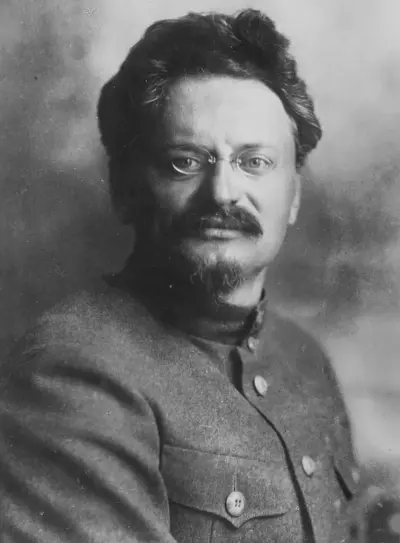
Lev Davidovich Bronstein, better known as Leon Trotsky (/ˈtrɒtski/), was a Russian Marxist revolutionary, political theorist and politician. Ideologically a communist, he developed a variant of Marxism which has become known as Trotskyism.
