Noam Chomsky Quotes
In 1949, China declared independence - an event known in Western discourse as 'the loss of China' in the U.S. - with bitter recriminations and conflict over who was responsible for that loss.
Chomsky, Noam. Who Rules the World?. Metropolitan Books, 2016.

The Kuomintang nationalists under Chiang Kai-Shek tried to stay in power in China, but their corruption and incompetency at government lost them the support of most of the Chinese. The Chinese communists took over the government. The Nationalists then invaded the offshore island of Taiwan but claimed to be the rightful government of all of China. For many years they controlled the Chinese seat in the UN and they refused to recognize the fact that they had failed to gain the loyalty of the Chinese people.
The Communists under Mao won the Civil War easily as the Nationalists were not only corrupt and very unpopular, but they were not very interested in the welfare of the Chinese peasants. Further Chiang was a ruthless dictator. At the time there was great pressure for America to support any faction that was anti Communist regardless of how bad they were themselves. Davies and others who thought that we should have communications with the Communists who would soon control China, were viciously attacked by Senator McCarthy who accused Davies of “loosing China” and the Senator and some other Americans thought that the Nationalists could win the Civil War. We now know that they never had a chance, but at the time they did a very good job of promoting their cause and capability in the United States and especially in Washington. None the less, in the Red Scare, Davies was fired, only to thereafter be awarded the highest civilian award in the nation in recognition of his great and patriotic work.


Many American ideologues assumed that the Chinese Communist Revolution would lead to an economic collapse. They did not realize that historically a competitive business economic system had been operational in the Chinese culture for thousands of years. In reality the economy was however really being suppressed somewhat by the Mau style of communism. When Deng loosened up the economic rules in China, their “Communist” system not only functioned as it had under Mao, but then thrived and China became a world economic power in just a relatively few years.

This was just a month after the Japanese sneak attack on Pearl Harbor. Anyone at that time, who promised to attack Japan would get a serious hearing, and Chiang Kai-shek and the China Lobby were making extraordinary promises. FDR wanted to give Chiang’s Nationalist government an extraordinary $½ Billion in aid. One interesting aspect of this quotation is the wording. Note that the President used the word “invent”. He realized that there was no existing mechanism whereby they could simply send such a huge block of money to a foreign country on the promise that they would use it for fighting the Japanese. If there were, he would have had the War Department or the State Department to do it. So he asked his most trusted and creative cabinet member to “invent” a way to do it. Morgenthau came through with a very complicated, elaborate scheme that Congress approved the following week. The money was sent, but Chiang Kai-shek did not spend it all for fighting the Japanese—his idea was to let the Chinese Communists under Mao wear themselves down fighting the Japanese, and Chiang could use the American military assets to then wipe out the communists, his only political opponents. See {641676}.


Wright, like so many idealists had been a communist before the reality about Stalin and Russia was public knowledge. He then became a virulent anti-Communist and appeared in many international gatherings of Black artists and intellectuals. However, he felt that the CIA funding of an organization called the American Society for African Culture was undermining his message and integrity.’
China has historically been so large and diverse that unity was difficult and very rare. Also, the Chinese have had a very expansive view of what China was. The Chinese have seen Tibet, Mongolia, Vietnam, parts of Burma and much of Asia as a part of the “motherland”.
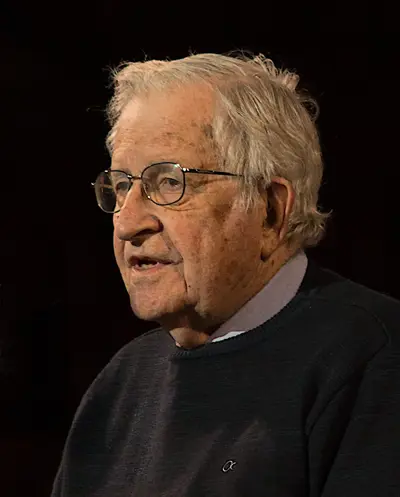
Avram Noam Chomsky is an American linguist, philosopher, cognitive scientist, historian, social critic, and political activist. Sometimes called "the father of modern linguistics", Chomsky is also a major figure in analytic philosophy and one of the founders of the field of cognitive science. He is Laureate Professor of Linguistics at the University of Arizona and Institute Professor Emeritus at the Massachusetts Institute of Technology (MIT), and is the author of more than 150 books on topics such as linguistics, war, politics, and mass media. Ideologically, he aligns with anarcho-syndicalism and libertarian socialism.
