William Blackstone Quotes
The Law of Moses became the font and spring of constitutional government.
William Blackstone, 1723-1780, British Jurist, Commentaries on the Laws of England, 1783
Sourced by: Eigen's Political and Historical Quotations

This is one of the characteristics of a theocracy—that all law comes from the Deity and religious law is civil law and vica versa. This is similar to the modern views held by the extreme conservative Muslims regarding their Islamic law, Sharia.

This is one of the best, short, historical summaries of the Ancient Jews’ governmental structure after the Exodus from Egypt. They had, to the best of our knowledge, the first republic, although the orthodox Jews do not credit the Jewish people. It was the Almighty who created the Republic and ordered them to live under it. Later, the Jews wanted Kings, and they had them, destroying the Jewish Republic and creating a Jewish Empire where the kings ranged from good to horrible. Ultra-orthodox Jews in modern Israel, reject the Democracy, and believe. Like ultra-orthodox Muslims, that God rules and not kings or the people or representatives chosen by the people.
The photo is Rev, Hunting’s original house—a historical landmark in Connecticut.

The Torah consists of the first 5 books of the Old Testament. For Orthodox Jews, the Torah is central and fundamental to their belief structure. In most democracies, a statement such as this might be made by a religions fundamentalist, but is unexpected when uttered by a high government official. However, in Israel there are several small religious political parties which oftem become very powerful when the major policies are of approximate equal strength. To entice them to join their coalition, the major parties give the religious parties cabinet positions. In this particular instance, Neeman’s party in the governing coalition could cause the government to fall, So a Justice Minister of a Modern Democracy can actually repudiate the laws and supreme court whenever they are not in harmony with “the word of God” and not lose his post or even be repudiated. There is probably no other country in the world where the Minister of Justice has repudiated the law of the land and the nation’s highest court.


There were those who disagreed with Sekulow, especially those whose religions did not recognize the Ten Commandments. Others see the Ten Commandments not in a religious sense but in a cultural sense and therefore the display in the Supreme Court—along with other world historical scenes of laws and lawgiving—was a historical and cultural display which did not help to “establish” any religion.

Gun control opponents quote this passage to give more legitimacy to all people being armed. God told the Jews, His chosen people, that every man should be armed. Gun control some argue goes against the will of God.


Note that not unlike Sharia, Islamic Law, this meant the death penalty for Witchcraft, Heresy, Adultery and Disobedient Children.


See {638125} for the assertion of God’s ownership of the land.
Anthony Ashley Cooper

Liberal has a somewhat different meaning in English politics than the word as used in America. In England, the opponents of conservatives are of the Labour Party. The Liberals are a third party who on some issues are liberal in American terms and on others, conservative. However, they are very tolerant and somewhat intellectual.


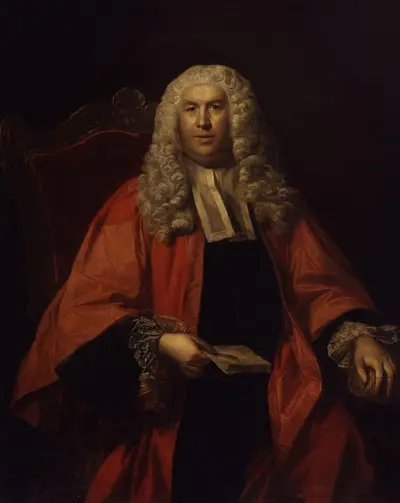
Sir William Blackstone SL KC was an English jurist, judge and Tory politician of the eighteenth century. He is most noted for writing the Commentaries on the Laws of England. Born into a middle-class family in London, Blackstone was educated at Charterhouse School before matriculating at Pembroke College, Oxford, in 1738. After switching to and completing a Bachelor of Civil Law degree, he was made a fellow of All Souls, Oxford, on 2 November 1743, admitted to Middle Temple, and called to the Bar there in 1746. Following a slow start to his career as a barrister, Blackstone became heavily involved in university administration, becoming accountant, treasurer and bursar on 28 November 1746 and Senior Bursar in 1750. Blackstone is considered responsible for completing the Codrington Library and Warton Building, and simplifying the complex accounting system used by the college. On 3 July 1753 he formally gave up his practice as a barrister and instead embarked on a series of lectures on English law, the first of their kind. These were massively successful, earning him a total of £453 (£71,000 in 2021 terms), and led to the publication of An Analysis of the Laws of England in 1756, which repeatedly sold out and was used to preface his later works.
