Michael Moore Quotes
The justice department spent more time and effort on Barry Bonds than all the financiers and bankers who ripped off the country with their bonds.
Barry Bonds was a star professional baseball player whose accomplishments were aided by taking illegal drugs. He lied about his use of drugs, and the Department made a very large effort over years to finally prosecute him. However during that time there were almost no prosecutions of the thousands of bankers and financiers who had lied, cheated, forged legal documents and in the process almost permanently ruined the American economy—the Great Recession of 2008. The Justice Department claimed that white collar cases are very complex and take longer to prepare prosecutions. Critics claimed that there are so many law breakers, that the government does not want to prosecute all the felons, but just go after a few, and this is easier if time has gone by and public anger has receded or been forgotten.
Michael Moore, Author, Political Commentator, and Documentary Film Creator, Interview, CNN May 5, 2011
Sourced by: Eigen's Political and Historical Quotations

At this time it was 6 years after the Home Financing Crisis and the Meltdown of 2008 and despite tens of thousands of law violations by the bank, the Justice Department was finally finishing their investigations and requiring some penalties. Other negotiations with other banks were in progress, but no bank executives were going to jail for the millions they handled fraudulently, whereas a burglar who stole household goods would do jail time.

Actually a few minor characters were prosecuted for financial crimes committed during that period but none were prosecuted whose behavior caused or accelerated the meltdown, and no bank officers were prosecuted despite the FBI reporting that hundreds of thousands of Mortgage Foreclosure involved perjury by bank officers in a pattern that was used by most of the large major banks. The Obama administration was in the dilemma of either choosing one or two bank officers of whom to make an example or if all those who had committed serious crimes were prosecutors, it would involve thousands of the officers of almost every major bank and tens of thousands of officials and mortgage related firms. These were among the wealthiest and most influential people in the country, and there would be few left to build the American Banking System back up when that was one of our most important national priorities. They were also amongst the largest political contributors to both political parties. So the government bailed the bankers out financially, allowed them to maintain million dollar of more salaries and bonuses, and gave the entire batch of people who broke the law a de facto immunity from criminal prosecution. A further complicating factor was that many of the most egregious, greedy, and publicly harmful were not illegal as a result of much change in the law as a part of financial deregulation or were new schemes that the financial industry had successfully lobbied to prevent regulation as with Derivatives.

The Senator asked Justice Department officials if the reason that there had been no prosecutions of any major financial figures associated with the Meltdown of 2008 and the Great Recession is that they were “too big to jail.” This appears to be the first public official to use this phrase. See {637991} for the Attorney General’s sad but truthful reply.

Greenspan was not the amoral fool that this quotation makes him seem. Despite the fact that he was the most important financial officer of the country, he had an ideological faith that a free market was self-corrective in a democracy. The financial industry would police itself he believed. He also trusted the self interest of the financial corporations to restrain them from getting too greedy -- {637989}. He and many others were wrong and most Americans paid the price.

In the economic meltdown of 2008 and the aftermath, there were so many criminal violations of law in the financial industry that even the Democratic administration of Barack Obama chose not to jail the violators but to levy some large token fines albeit ones which were very affordable for the institutions who had to pay them—in many cases paying them with money made as a result of profits on no-interest money they received in bailouts after the 2008 Meltdown.
He was replying to Senator Grassley--{637990}. This quotation is one of the saddest admissions in American law enforcement and corporate regulatory history. A small group of very wealthy men, working for huge financial corporations caused the worst financial crisis since the Great Depression. The Government regulators were reined in by the Bush Presidential administration and were none to competent anyway. The Clinton Administration repealed the Glass Stiegel Act allowing banks to gamble with customer’s The Congress made matters worse by kowtowing to the housing and real estate special interests and overheating the housing market. But with all that some of the many of the financial executives committed crimes ranging from financial fraud to forgery of court documents. But they had put the country into such a poor economic state, that the Obama administration feared that prosecution of some of the leading financial executive criminals would spook the financial markets and cause an even greater economic situation. At least the Attorney General admitted the truth of Senator Grassley’s suspicion--{637990}.

In the Savings & Loan crises there were under 1000 bankers and others who had committed crimes, In the Meltdown of 2008, there were tens of thousands of criminals. Almost everyone connected with home mortgages broke the law, and all of the major banks in America had officers at the highest levels who committed perjury and fraud regarding foreclosure of mortgages. The biggest fish were involved as well as many thousands of others. Wall Street and the financial industry spend many millions in lobbying and campaign donations to be sure that there would be very few prosecutions and even then no major financial leaders would be called to account in a criminal court. The FBI had identified MILLIONS of cases of perjury and fraud in bank forclosures alone.

In the Great Recession thousands of bank executives of the banks that received government bailouts committed fraud and perjury providing false information under oath and foreclosing on mortgages illegally. There were so many bank felons that the Justice Department decided not to prosecute any of them and let the Banks pay relatively small fines instead. Then the banks paid the crooked employees bonuses. Paul was one of the few members of Congress who favored prosecution of all the guilty bankers regardless of the number.

The then attorney general had begun a series of investigation which discovered that most of the major Wall Street brokerage houses were engaged in systematic frauds to cheat small investors. One dramatic fraud he uncovered was that the research expert analysts of major firms would recommend the stock of businesses that their firm was doing investment banking for even when they knew that the companies were not doing well or were even in deep financial trouble. See {627544}.


This was yet another warning about an area that became a major factor 4 years later in the Meltdown of 2008 and the Great Recession. The George W. Bush administration, however, rejected proposals to prevent more mortgage abuses by regulating the banks and mortgage brokerage industry more.


In the Meldown of 2008 which caused the Great Recession, he, his Republican Predecessor and Ben Bernanke, the Federal Reserve Chairman, I the opinion of most on ideological economists saved the American economy from a collapse that would have been as bad or worse than the Great Depression. However, to accomplish that they had to in effect bail out the banks, 2 of the 3 American Auto companies, and the largest insurance company with taxpayer money. Worse, they could not do much for the millions of Americans whose homes were “under water” as a result of the banks’ handling of home mortgages and mortgage backed securities. To help them, they would have had to force the banks to admit that their assets were much lower than the banks were claiming and the banking and financial executives had to be appeased. Meanwhile, they had few other resources and did not provide any help to Main Street, small business or even small banks. Worse, they were intimidated into allowing the subsidized and saved banks to pay huge bonuses to their executives whose performance was terrible while millions of normal Americans were unemployed and the others were getting no increase in compensation. See {639655} for Geither’s explanation of the problem.
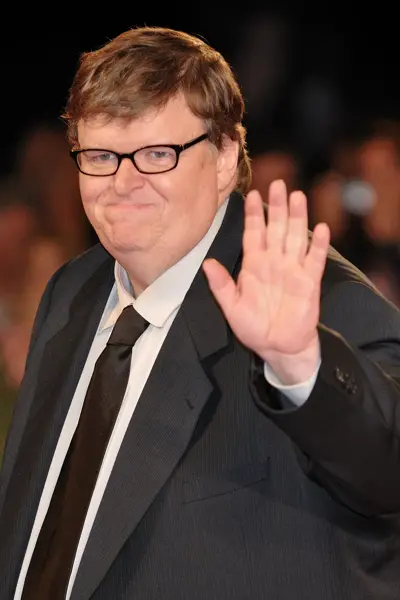
Michael Francis Moore is an American documentary filmmaker, author, and activist. His works frequently address the topics of globalization and capitalism.
