Howard Dean Quotes
the idea that you have to wait on line for eight hours to cast your ballot in Florida -- there's something the matter with that. You think people can work all day and then pick up their kids at child care or wherever, and get home and then have a -- still manage to sandwich in an eight-hour vote? Well, Republicans, I guess, can do that, because a lot of them have never made an honest living in their lives. But for ordinary working people, who have to work eight hours a day, they have kids, they got to get home to those kids, the idea of making them stand for eight hours to cast their ballot for democracy is wrong. We ought to make voting easier to do. Mail
Howard Dean Governor of Vermont (Democrat), Physician, Unsuccessful Candidate for the Democratic Presidential Nomination, Chairman of the Democratic National Party, Take Back America 2005 conference, in Washington DC, June 2, 2005
Sourced by: Eigen's Political and Historical Quotations


The speech was delivered at the Lincoln Memorial on the 50th anniversary of the Civil Rights March on Washington in 1963.


The marshal was embarrassed by his assignment to arrest this famous, elderly woman. He refused to handcuff her, gave her time to change her clothes, and took Anthony by streetcar to the courthouse trying to keep as low a profile as possible while Anthony was making speeches all the way about her unjust arrest. She was found guilty and fined $100 which she never paid.


Opposing national attempts to give Blacks the vote in the South:


Of the men who conceived and carried out the Watergate break-in:


The voting problems we have had are managerially and technology solvable but politically each solution is perceived as favoring one of the political parties in the particular jurisdiction and therefore there is resistance to the change.

In the beginning of the 21st century, many republican state legislatures attempted to change the voting laws to eliminate the possibility of voter fraud which was not a serious practical problem in America. However, a consequence—some argue indented and some argue unintended—was that it was harder for certain groups of people to meet the new requirements and therefore was a de facto voter suppression for some people such as the very elderly, the homeless, and the poor. Many of these efforts were declared unconstitutional by the courts.

He was stating the major objections that were given by many of the royalty and the upper class who opposed universal suffrage. Milton however supported the right of all men to vote. See {632509}. Even in the 21st century, there are right wingers who oppose universal suffrage on the grounds that the lower classes vote only concerned by what they materially will obtain, as if many people of all classes do not do that and that all poor do. For additional reasons see {632533}.


The Republicans had been very effective in staffing off all attempts to strengthen gun control legislation. In addition, in a number of states they passed legislation reducing the voting days, times and places and requiring driver’s licenses or equivalent picture ID at the time of registration voting. Election day, not being a work holiday in America, it is harder for less affluent people to arrange their schedules and get to polling places, so restrictions tend to reduce their voting more so than for affluent citizens. The former tend not to vote for Republicans, so this was a very effective political strategy, albeit many questioned the morality, the fairness, the legality and the long term value to the nation.

Most Americans thought that this issue was settled long ago, but there are still some revanchist conservatives who are fighting the fight of the 18th and 19th century democracies of restricting voting to only the “educated” or “property” classes.


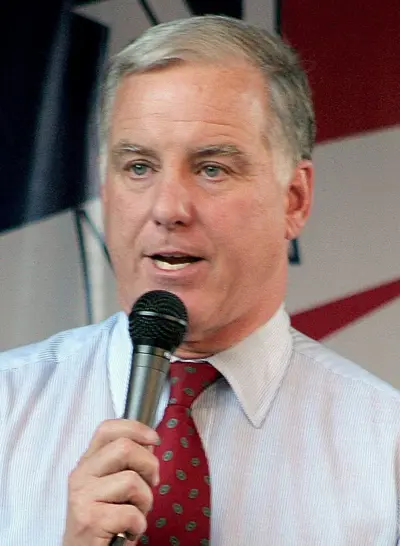
Howard Brush Dean III is an American physician, author, lobbyist, and retired politician who served as Governor of Vermont from 1991 to 2003 and Chair of the Democratic National Committee (DNC) from 2005 to 2009. Dean was a candidate for the Democratic nomination in the 2004 presidential election. His implementation of the fifty-state strategy as head of the DNC is credited with the Democratic victories in the 2006 and 2008 elections. Afterward, he became a political commentator and consultant to McKenna Long & Aldridge, a law and lobbying firm.
