Scott Gottlieb Quotes
The higher cost of getting a generic drug approved by regulators means that many old medicines don't face competitors. It's only after substantial price hikes that these drugs offer enough revenue to offset the rising generic entry costs, and start to entice competition.
Gottlieb, Scott. "The FDA's Generic-Drug Monopoly." The Wall Street Journal, 19 Aug. 2016.


In 1989 the company that owned the only drug that was helpful in treating AIDS had not yet made it available for children:

The Bayh-Dole Act (Patent and Trademark Law Amendments Act) for the first time allowed universities which held patents obtained as a result of Government Funded Research to enter into agreements with corporations to develop new drugs from those patents. The theory was that, the number of new drugs brought to the market would substantially increase beyond only the hundred or so that appeared each year. Unfortunately, the legislation did not have the desired effect. By the first decade of the 21st century, the number of annual NEW drugs being brought to market was under 30 and in 2010 was only 10. The cost of going through required trials for FDA drug approval has reached hundreds of millions of dollars, and most organizations cannot afford to even make the attempt. Even if a drug is very promising, the drug companies will not invest the money unless there are enough people suffering from the malady the drug treats and the medicine has to be taken for a long time as with chronic conditions. The system works poorly for the society and the health system. Reforms are needed.
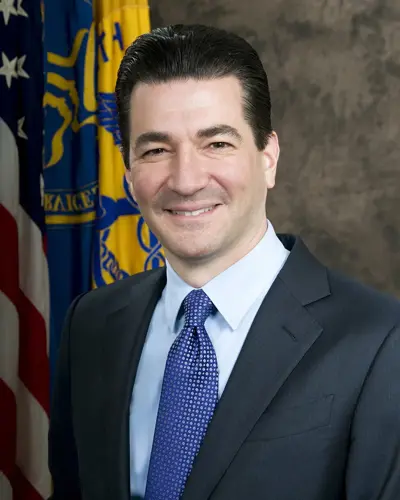
Scott Gottlieb is an American physician and investor who served as the 23rd commissioner of the Food and Drug Administration (FDA) from 2017 until April 2019. He is presently a resident fellow at the conservative think tank the American Enterprise Institute (AEI), a partner at the venture capital firm New Enterprise Associates (NEA), a member of the board of directors of drug maker Pfizer, Inc, a member of the board of directors of Illumina, Inc., and a contributor to the cable financial news network CNBC. Before becoming FDA commissioner, he was a clinical assistant professor at New York University School of Medicine, the FDA deputy commissioner for medical and scientific affairs, a venture partner with New Enterprise Associates, a member of the policy board of the Leukemia & Lymphoma Society, a senior official at the Centers for Medicare and Medicaid Services, and a member of the Federal Health Information Technology Policy Committee, which advises the United States Department of Health and Human Services on healthcare information technology. He was previously a resident fellow at AEI from 2007 to 2017 prior to joining the FDA as commissioner in May 2017.
