Lin Zexu Quotes
The head of England is a woman, and quite young, and all orders come from her.
Lin Zexu, 1785-1850, Chinese Scholar & Imperial Commissioner of Guangdong, Governor-General of Shaanxi-Gansu, Reference to Queen Victoria
Sourced by: Eigen's Political and Historical Quotations


After the King’s appointment in 1921 she “advised” him on establishing this regime and operating the government. At a time that women could not even vote in England, Bell was a kingmaker and major power in an area of the world that was much more sexist than England at the time.

This was written shortly before he assumed the crown.

Prior to Cooke’s indictment of English King Charles I, there was a concept of Royal Impunity—that a sovereign could not legally be called to account for his actions as ruler of the state. The concept of “sovereign immunity” was a concept where the sovereign and his agents could be given immunity for specific actions, but they never would have impunity again where there were no limits to the crimes they might commit against their own people. Charles I refused to even recognize Cooke’s indictment and so have heads of state called to account for their major crimes since then all the way down to Saddam Hussein in 2006 who made the same argument. Cooke was himself hanged, drawn and quartered almost 20 years after the Charles I trial for his part in the “Regicide” so the concept of Royal Impunity did not die quickly.

Lord Palmerston, John Henry Temple, had been the Foreign Minister. He had a style which like President George W. Bush, was perceived by foreign governments to be condescending and insulting. His policies were generally in line with the Prime Minister’s desires and the Queen’s but he was involved with one negative incident after another. England had sunk to it’s lowest public opinion assessment European had seen in years. The Queen was very distressed. Palmerstone a very senior and popular politician with a great deal of experience resented this young girl micromanaging his policies and statements. On several occasions he went ahead with a policy “forgetting” to clear it with the Queen in advance. To the degree the Queen had a political enemy, Palmerston was it. He controlled an important bloc of Prime Minister John Russell’s narrowly ruling party. When the Queen talked to the Prime Minister about firing the Foreign Secretary, Russell always pointed out that while there were ample grounds for firing, pragmatically he might not be able to hold a majority without the Foreign Secretary in the Cabinet. The Queen had great respect for Russell and did not wish the government to be in a crises so she repeatedly put up with Palmerston’s gaffs and insult. After a few years the political situation changed and Palmerston was no longer critical to the government and at his next incident the Prime Minister and the Queen agreed to terminate the Foreign Secretary. The quotation shows the Queen wanting the Prime minister to avoid embarrassing the man who had vexed her for several years. She was very “lady-like” and showed no interest in payback or vengeance. Many historians argue that if she were a male king, Palmerston would have been gone long before regardless of the cost as he had challenged the monarch. However, perhaps a female national leader does not have the instinct from the rutting male mammals that men seem to show when they deal with rivals. Palmerston was eased out of office with great praise and thanks from the Prime Minister and the Queen.


She responded to the Lord Chief Justice and to Lord Cecil and asked them to so inform the Commons and the House of Lords. Cecil needed three drafts to convey the response but tone it down a little, thus performing the duties of a modern press secretary.


In 1875 Benjamin Disraeli had an opportunity to purchase the Suez Canal for Great Britain from the Khedive of Egypt who was in great need of cash. However, Disraeli had to act very fast and there was no way to quickly move an appropriation of the then very large sum of 4 million pounds through Parliament. So he sent Corry to ask Lionel Rothchild, the British financier, for a loan until the government might raise the money. Rothchild asked, what would be the security for such a large loan. Rothchild immediately gave the loan.

The Queen died later that year.


Actually, Queen Elisabeth II, at that time the Queen of England, was very sophisticated about the policies of the nation. Chomsky’s point was not that the Queen was ignorant; it was that her role is ceremonial and it is not critical or even material that the monarch in a Constitutional Democracy understands or approves of the government program that is being presented.


Note that the Queen always used the 3rd person rather than the 1st when referring to herself. This was true of most of the leading public figures in England at the time. Although she detested Gladstone, she gained control of her feelings and did her duty and “sent for” him to form the Government. She was personally delighted when, as she predicted, his government then had political difficulties.

Some of the Patriots of Early America realized that the oppressions of British rule were coming from Parliament and initially took the position that only the King could make laws for the colonies and not Parliament. Therefore, they were as Englishmen challenging illegal English laws. Most American hostility was directed at Parliament and not the King. However, once there was any physical resistance, King George came down with such a heavy hand that American hatred transferred to him. For related quotes on the King/Parliament issue, see {639145}, {639144}, {639142}, {639141}, {639140}, & {639137}
The statement so offended the Lords—the highest court of England—that he was imprisoned by the Lords and not released until he had recanted the position. The argument goes on today in many countries incuding the United States.

West Saxons had a bad experience with a “Queen” who was not very good. This quotation illustrates that the institutions of monarchy varied from time to time and place to place, just like democracies that have many differences among them.


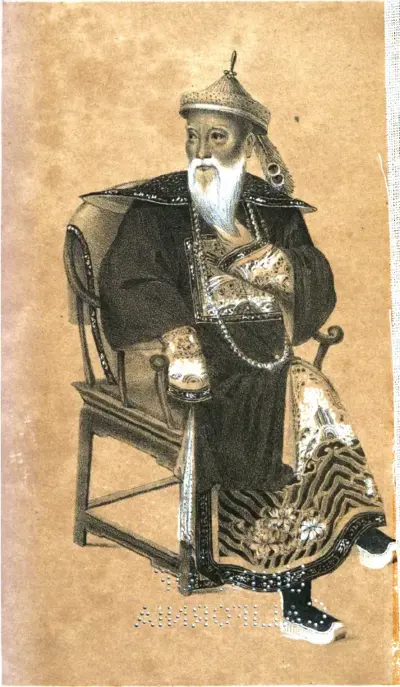
Lin Zexu, courtesy name Yuanfu, was a Chinese head of states (Viceroy), Governor General, scholar-official under Emperor of the Qing dynasty best known for his role in the First Opium War of 1839–42. He was from Fuzhou, Fujian Province. Lin's forceful opposition to the opium trade was a primary catalyst for the First Opium War. He is praised for his constant position on the "moral high ground" in his fight, but he is also blamed for a rigid approach which failed to account for the domestic and international complexities of the problem. The Daoguang Emperor endorsed the hardline policies and anti-drugs movement advocated by Lin, but then blamed Lin for the resulting disastrous war.
