Robert M. La Follette Quotes
The "have nots" outnumber the "haves." No wonder the ruling class of every country grows more and more alarmed.
Robert M. La Follette, 1855-1925, Governor of Wisconsin (Republican), U.S. Senator (Republican, WI), Presidential Candidate (Progressive), Letter to his family, December 28, 1918
Sourced by: Eigen's Political and Historical Quotations


This novel won the Booker Prize—one of the great achievements in literature.


The crisis of inequality of income and wealth has occurred seven times in American history.

Referring to the urban poverty in mid-nineteenth century Spain.


1st Earl of Beaconsfield. See Thomas Jefferson for a similar view.


The Supreme Court had ruled that there could be no limits placed on the amount of money that could be spent by a rich company or person to campaign for a candidate. It would deny them their right to freedom of speech. That was the context of Hollings’ remark.


After Roosevelt, most eras of American politics more or less followed the pattern Roosevelt described herein as a “calamity”, with the anger becoming more or less intense. Jefferson thought that these were natural divisions of politics in all societies--{604810}. The thing that masked this for years was race and slavery. In Lincoln’s time there were liberals and conservatives in both parties if race were ignored. In Theodore Roosevelt’s era, he, Taft and others were generally liberal reformers, while a large number of Republicans were conservative supporters of the status quo. Some democrats were radical reformers like William Jennings Bryan while others were arch conservatives. Until 1964 and the Civil Rights Act there were many conservatives in the Democratic Party, but almost all switched to the Republican Party in anger. The Republican conservatives tended to drive the Republican liberals out of the party and for the last part of the 20th century Roosevelt’s “calamity” well described the American political scene, and the anger increased carrying partisan bitterness into the 21st century.


The term “rugged individualism” was used at the time be very conservatives and the very wealthy to describe business leladers with words that had very good public connotations. They argued that it would be undesirable to curtail their individualism that was so important by any government regulations or laws that would limit what the business leaders could do. However, the reality was that these very successful and powerful “rugged individualists” had regimented most everyone else—employees, consumers, and small businessmen who might sell them services or products. To Tugwell, if the wealthy and powerful few had no restrictions on their individualism, there would be precious little individualism for most of society. He sought a balance of regulating the individualism and prerogatives of the few somewhat in order to allow the vast majority of people to be able to have individuality as well.


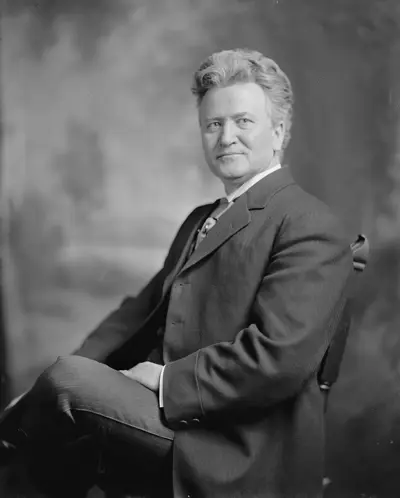
Robert Marion "Fighting Bob" La Follette Sr., was an American lawyer and politician. He represented Wisconsin in both chambers of Congress and served as the Governor of Wisconsin. A Republican for most of his career, he ran for President of the United States as the nominee of his own Progressive Party in the 1924 presidential election. Historian John D. Buenker describes La Follette as "the most celebrated figure in Wisconsin history."
