Judah P. Benjamin Quotes
The gentleman will please remember that when his half-civilized ancestors were hunting wild boar in Silesia, mine were princes of the earth.
Replying to a Senator who had made an anti-Semitic remark:
Judah P. Benjamin, 1811-1884, U. S. Senator (Whig & Democrat, LA), Confederate Attorney General, Secretary of War, & Secretary of State, Attributed
Sourced by: Eigen's Political and Historical Quotations


Disraeli was attacked for being Jewish: 1st Earl of Beaconsfield


Here we have a very mockery of the concept of aristocracy and “good family”. This humorous essay was written less than a decade after Darwin published his first treatise on evolution. Here a witty American essayist and critic is giving an insight into the thoughts of the many people who either were scandalized by the concept of human evolution or honestly could not grasp such a new intellectual set of concepts. Many of the great scientific intellectual breakthroughs spread with stunning rapidly—usually amongst scientists, but in the case of evolution to most intellectuals and men of letters, they could use Darwin’s framework and observe evidence of evolution all over. So here, less than 10 years from the inception of evolutionary theory among English scientist, we have American non-scientific literati reading articles in the general (albeit sophisticated) Atlantic Monthly with a semi-serious, semi-comical, analysis of the thinking of people who resisted what had become in just a few years obvious truth to America’s leading intellectuals (except for most of the leading intellectual theologians who would take longer to accept evolution, but, with the exception of the extreme fundamentalists, most did.


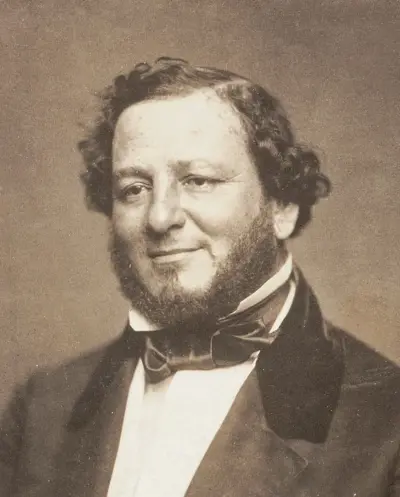
Judah Philip Benjamin, QC was a lawyer and politician who was a United States Senator from Louisiana, a Cabinet officer of the Confederate States and, after his escape to the United Kingdom at the end of the American Civil War, an English barrister. Benjamin was the first Jew to hold a Cabinet position in North America and the first to be elected to the United States Senate who had not renounced his faith.
