Martin Luther Quotes
The fool will upset the whole science of astronomy.
Luther, Martin. Luther's Works, Vol. 54: Table Talk. Edited by Theodore G. Tappert, Fortress Press, 1967, p. 358.


Economics has never been a precise science which is one of the reasons it is called the “dismal science.” In the final analysis economics depends on the behavior of people—rational and irrational.


He was known as “The Christian Cicero” because of his rhetoric. He contributed little original Christian thought but communicated it more so than anyone had done before. Interestingly, the early church fathers did not see the concept of a round earth as heretical—just absurd. When the idea began to be seen as potentially serious heresy would be almost 1000 years later.


Huntington, one of the better known political scientists had been nominated for admission as a fellow of the National Academy of Sciences. He was generally considered a shoe-in. However, some of his research had used extensive mathematical analysis to prove his conclusions. Lang a gadfly had actually read Huntington’s peer reviewed published Journal articles and found that the mathematics was very faulty, both in its application and execution. He opposed Huntington’s election and proceeded to present Huntington’s mathematics and conclusions to the members, who were themselves the best scientists of many different disciplines. They all realized that the Huntington work was incorrect. Huntington argued that as a Political Scientist he was using mathematics as a way of conceptually illustrating his points and not in a rigorous manner. Huntington was not elected to the academy. Lang frequently would take scientific evidence offered in Congressional Hearings, analyze it and then send a package to the media and members of Congress showing the errors. See {508154} for his cutting style with poor science.

First Astronomy, then Geology, proved that the Creation that was described in the Bible was not literally correct. To religious fundamentalists who believe that every word of the Bible is the word of God or the word of those inspired by God, the only possibility of conclusion is that the science is wrong. To the extent that undermining the word of God is not acceptable to the fundamentalists, they have used every power—including the criminal law power of the state to stop the blasphemy and discredit the scientist. In 1856, there was a much larger proportion of fundamentalists in the Western World than there is today. By 2012, the vast majority of these same populations have rejected Christian Biblical Fundamentalism, and no longer attack science for its affect on religion. The minority of fundamentalists, however, are vehement in their opposition to science.


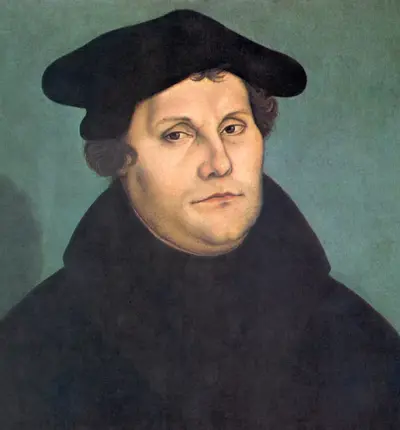
Martin Luther, O.S.A. was a German professor of theology, priest, author, composer, Augustinian monk, and a seminal figure in the Reformation. Luther was ordained to the priesthood in 1507. He came to reject several teachings and practices of the Roman Catholic Church; in particular, he disputed the view on indulgences. Luther proposed an academic discussion of the practice and efficacy of indulgences in his Ninety-five Theses of 1517. His refusal to renounce all of his writings at the demand of Pope Leo X in 1520 and the Holy Roman Emperor Charles V at the Diet of Worms in 1521 resulted in his excommunication by the pope and condemnation as an outlaw by the Holy Roman Emperor.
