Ernest Hemingway Quotes
The first panacea for a mismanaged nation is inflation of the currency; the second is war. Both bring a temporary prosperity; both bring a permanent ruin. But both are the refuge of political and economic opportunists.
Ernest Hemingway, 1899–1961, Nobel Laureate in Literature, “Notes on the Next War: A Serious Topical Letter", Esquire, September 1935
Sourced by: Eigen's Political and Historical Quotations


Conservatives are surprised to learn that their great economic nemesis was one of the early economists who saw the danger of paper money and government control over the minting of money which is one of their core concerns.


Note the candor with which the Congress provided the truth to Americans about the financial situation of the nation. Despite the national crises and emergency of the war, the Congress told the truth and did not treat the citizens as children from whom bad news must be withheld. At the time, each state and many individual banks had their own paper currency, these could be easily counterfeited and were done so by the British to collapse the American economy. Because of this early traumatic experience with paper money, the United States did not use it for another 70 years.

At the time the United States was on the Gold Standard and all our money was backed by gold. Root and others were afraid that a Federal Reserve Bank, a proposal that was being debated in Congress, would cause a large amount of paper money to be printed which other nations would obtain through trade and then exchange that for American gold—a process which would deplete the American gold supply. A few years before, William Jennings Bryan had argued that the Gold Standard did not allow America sufficient ability to increase the money supply to serve the growing population and economy. See {640992}.


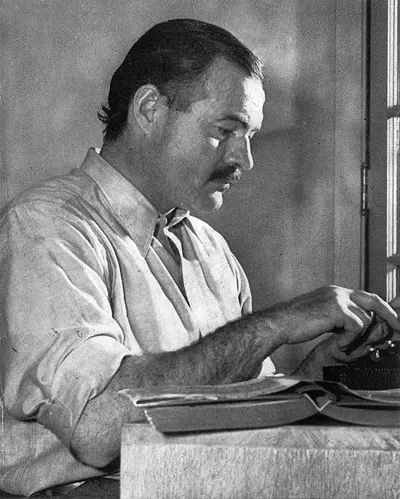
Ernest Miller Hemingway was an American novelist, short-story writer, journalist, and sportsman. His economical and understated style—which he termed the iceberg theory—had a strong influence on 20th-century fiction, while his adventurous lifestyle and his public image brought him admiration from later generations. Hemingway produced most of his work between the mid-1920s and the mid-1950s, and he was awarded the Nobel Prize in Literature in 1954. He published seven novels, six short-story collections, and two nonfiction works. Three of his novels, four short-story collections, and three nonfiction works were published posthumously. Many of his works are considered classics of American literature.
