Thurgood Marshall Quotes
The exclusion of jurors opposed to the death penalty allows the state a special advantage in those prosecutions where the charges are most serious and the possible punishment the most severe.
Thurgood Marshall, 1909-1993, U. S. Supreme Court Justice, Dissent, 1986
Sourced by: Eigen's Political and Historical Quotations


This constitution was written 7 years before the national constitutional convention. It shows that there was concern about the separation of powers in United States even before the Constitution was drafted. See {616749} for an even clearer statement of the separation of powers principle. The national legislatures in Europe had commonly declared people traitors and in many cases incarcerated or executed them. This clause, effectively presaged the national constitution of 1787 where the Congress was prohibited from trying people for treason or anything else except impearchment.

Roman law shaped European law for centuries. Even in the most dictatorial regimes of monarchies usually felt an obligation to avoid summary execution and have a trial, even if a crude, trumped up one involving torture of the accused. This Roman law had a long and profound influence.


Althought most of Seale’s “solutions” were counterproductive and/or ineffectual, and the Black Panthers were regarded as public enemies, Seale was right about some of his complaints including this one. In most of the South the changes forced by the Civil Rights and Voting Rights Acts where just beginning to have significant effect. So there were proportionately very few Blacks on Southern Juries. Even in the North, Blacks did not register to vote in proportion to their numbers so since jury pools were then usually drawn from voter registration lists, Blacks were statistically underrepresented. When a few Blacks were put on a jury panel, the prosecutor had the right of preemptory challenge as did the defense. But there were enough challenges so that the prosecutor could disqualify all the African Americans on the Jury. Even today, this is legal in many jurisdictions and although better than in 1970, then a Black defendant would rarely have African Americans on the jury of “his peers.”

In modern America, we have improved somewhat. Now both kinds of issues take many years.

This is a very important and fundamental quotation. Jefferson, John Adams, John Jay and many other Founding Fathers told us that the jury of peers was the final arbiter of a court case. However, many modern judges and legislatures have tried to erode that principle. In most states judges instructs juries that they are the final arbiter of the facts but he/she is the final arbiter of the law and how it should be applied in the case. But the founders wanted the jury to be the final arbiters of the law as well as the facts as is illustrated here and in {640587} and {640589}. For a more modern concurring view, see {640590}.


This principle that the jury may, if it chooses, decide on the law and not neccessarily follow the Judges instructions on the law was held by John Adams and John Jay, the first Chief Justice of the Supreme Court, as well as political and judicial leaders throughout American History. But in the 20th century the Judiciary and many legeslatures has tried to restrict taht freedom of the Juries. At the beginning of the 21st Century, the only state whose laws explictly followed that practice was Maryland, and even there, very few judges ever informed juries that they could override or ignore him on matters of law.


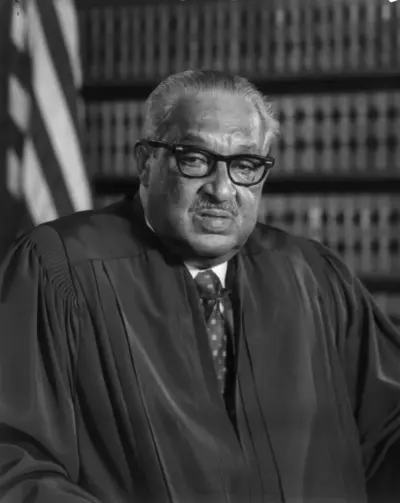
Thurgood Marshall was an American lawyer and civil rights activist who served as Associate Justice of the Supreme Court of the United States from October 1967 until October 1991. Marshall was the Court's first African-American justice. Prior to his judicial service, he successfully argued several cases before the Supreme Court, including Brown v. Board of Education.
