Richard P. Feynman Quotes
The exception tests the rule. Or, put another way, The exception proves that the rule is wrong." That is the principle of science. If there is an exception to any rule, and if it can be proved by observation, that rule is wrong.
This is a very important quotation because it illustrates a large difference between ideological politics and science and scientific thinking. As an example, one of the must fundamental rules of conservative Republicans at the beginning of the 21st century was that “If taxes are raised, the economic consequences will be that growth and development of jobs will slow. In the last 6 years of Ronald Reagan’s administration, he raised taxes. Yet the economy grew. In the early years of the Clinton administration income tax rates were increased, and America had the greatest growth rate in modern times as well as a balanced budget with a surplus. There have been a few other examples of “exceptions” to this “rule.” There were also many examples where the rule held. However, from a scientific point of view, with the FIRST exception the rule (principle) was invalidated. Yet Republicans continue to use and quote the rule which is clearly untrue. The scientist would likely have amended the rule to reflect reality: “In many cases, raising income tax rates will often slow economic growth.” However, politicians commonly state principles and rules despite the fact that there are exceptions. As for the statement “the exception proves the rule” there are few as absurd. One exception means no valid rule.
Richard P. Feynman, 1918-1988, Nobel Laureate in Physics, Member, Commission investigating the Challenger accident, The Meaning of It All, 1999
Sourced by: Eigen's Political and Historical Quotations


This quotation illustrates and important aspect of science. Specifically, that theory, something ephemeral and impractical to the layman, has immense practical power in developing great scientific and technological breakthroughs. The result of this breakthrough was large lenses that could make lights more powerful and make lighthouses much more safe. Even the atomic bomb was really developed from theory and then engineered for practical use.


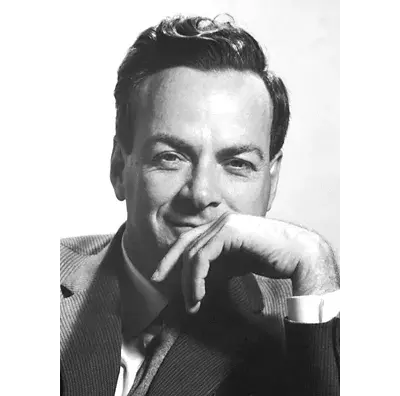
Richard Phillips Feynman was an American theoretical physicist and Nobel Prize winner who made significant contributions to quantum mechanics, quantum electrodynamics, and particle physics. He's known for his work on the Manhattan Project, developing Feynman diagrams, and explaining the interactions between light and matter. While studying for his PhD, Feynman participated in the Manhattan Project and helped develop the atomic bomb. For contributions to the development of quantum electrodynamics, Feynman received the Nobel Prize in Physics in 1965 jointly with Julian Schwinger and Shin'ichirō Tomonaga.
