Arnold J. Toynbee Quotes
The English laborer today is far more easy to move than he was 100 years ago. In a stirring new country like America there is much more mobility of labour than in England.
It was fairly common for Englishmen to never have been more than 50 miles from his place of birth. Transportation was slow and crude and expensive. At the same time, economic conditions were relatively good in England eliminating the necessity of migration for survival—unlike Scotland which had much more mobility. Although Toynbee observed the greater mobility of labor in the United States, at the time it was much less than it became with the construction of the National Highway System and the dominance of the automobile as a mode of transportation followed by low cost air transport.
Arnold J. Toynbee, 1899-1975, British Historian, Lectures on the Industrial Revolution of the 18th Century in England
Sourced by: Eigen's Political and Historical Quotations

Henry Ford had more than doubled the market wages of workers and shortened the work day. In his young years he hired Negroes to work on the Assembly line with whites. In his older years he would not when he had become a Hitler and Fascist admiring racist. This was of the Black migrations to Detroit to work in the Auto industry. See {642361} for Ford’s wage announcement.


to a carriage on wheels At the time Jefferson had never seen a train.


The American Dream is the reasonable possiblity of upward mobility, and at the time of this statement, a person growing up in Canada had twice the chance of an American of Achieving that.

Ford, an inveterate racist and anti-Semitic in his old age was very liberal when he first started and accomplished so much. He not only hired foreigners, but also some men of his initial workforce were handicapped. He was proud of the fact that jobs could be created on his concept of an assembly line that was so specialized that handicapped people could be productive workers as they did not have to do everything in the manufacturing process. Since the assembly line did the moving, men who had trouble walking could sit and be very productive at some tasks. Further, Ford did not try and pay his assembly line workers less than the going wage because their skills could be much narrower. He actually doubled the salaries (see {642361}) and picked men who were not wed to the older, traditional way of manufacturing things. The productivity came from the engineering of the cars and the assembly line, not be cutting wages, a practice that he did not continue as he grew older and tried to make his money the traditional way of exploiting the workers more. When the other auto companies had recognized the union, the elder Ford would not.


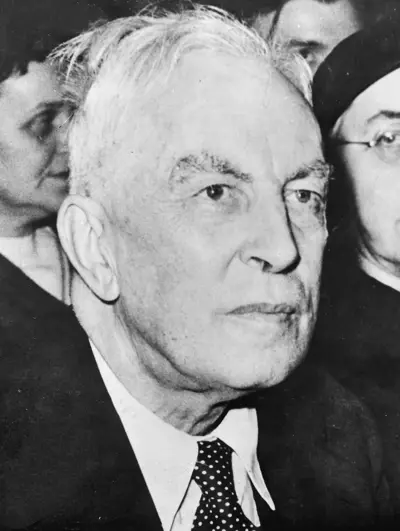
Arnold Joseph Toynbee CH FBA was a British historian, a philosopher of history, an author of numerous books and a research professor of international history at the London School of Economics and King's College London. From 1918 to 1950, Toynbee was considered a leading specialist on international affairs.
