Meyer London Quotes
The emancipation of the masses can become a reality only with the abolition of the competitive system of society.
Meyer London, 1871-1926, U. S. Congressman (Socialist, NY), Speech, U.S. Congress, 1916
Sourced by: Eigen's Political and Historical Quotations


This statement from an avowed Marxist illustrates the complexity of the Cold War. Marxists and Communists like Pannekoek felt that there had to be a workers’ movement to overcome the capitalist interest in a nuclear arms race. However, they also believed that Russia had botched communism so badly that there could be no workers’ movement in the Soviet Union because of the repression. Only in America they believed could the impetus for disarmament come.


This was the basic document issued after the Russian Revolution establishing the basic legal and economic structure of the new Soviet State. In one of the great ironies, the Communist state forced people to work, while the capitalistic United States and most of the European Countries so this as an invasion of rights and even provided welfare and other assistance to those who did not work as well as to others.

This was the basic document issued after the Russian Revolution establishing the basic legal and economic structure of the new Soviet State.


During Southern slavery, the poor white of the South had almost no prospects. He was always competing against slave labor which held his wages very low. At first he could he could get by if he had a trade—a carpenter, a blacksmith, a teamster, etc. However, soon slave owners invested in training some of their slaves, so even a white Southern tradesman could not earn a high wage as a Northern tradesman did. Unfortunately, the Southern upper class persuaded the poor whites that if slaves were emancipated they would be greater competition than they were under slavery, and there never was the common interest with the Northern labor that Emerson hypothesized.


Big Bill Haywood. Historically, the upper economic and business class, including currently, tend to view all labor organizations and unions as socialistic and or communistic and attach them for being such. However, in many industries in America today labor has a great deal of power and the industries are not socialistic or communist. The IWW however was one of the labor organizations that was based on socialism and contained many communists over the years. Haywood himself was a leader of the Socialist Party and campaigned for Eugene Debbs. Like Debbs he was convicted of an unconstitutional law of speaking against the WWI draft. Unlike Debbs who went to prison and was released later, Haywood skipped bail and lived in Russia for the rest of his life.


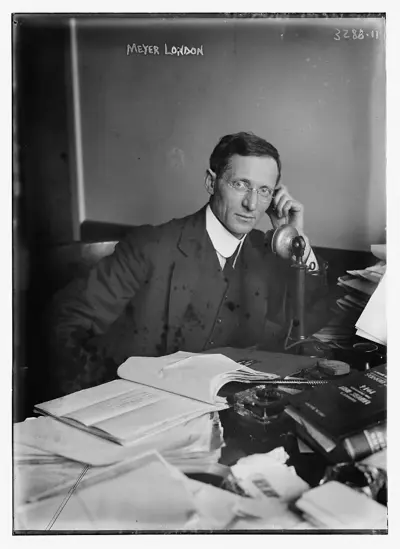
Meyer London was an American politician from New York City. He represented the Lower East Side of Manhattan and was one of only two members of the Socialist Party of America elected to the United States Congress.
