Louis D. Brandeis Quotes
The Depression has caused an emergency more serious than war.
Louis D. Brandeis, 1856-1941, U. S. Supreme Court Justice, Dissent, New State Ice Company v. Leibmann, 1932
Sourced by: Eigen's Political and Historical Quotations


New York’s highest court


Statement made in response to Jimmy Carter's technical arguments about the economy at a Teamsters convention in Ohio.


The Great Depression had worldwide reach. Just as Herbert Hoover and his followers felt that there was no role of the national government in dealing with the depression, Japan had a major faction that believed that the only thing to do was wait the economic cycle out. Hiranuma represented the more activist faction who saw the necessity of national government involvement.


Essentially Mellon told the President to let the entire economy crash. With huge numbers of people out of work, labor would be more humble and not only settle for lower wages, but will work harder, and without "excess" income beyond their basic needs, they would not drink and engage in other immoral activities. President Hoover, a wealthy man himself, did not go along with Mellon's idea of making the situation worse, but his conservative philosophy of government would not allow the Government to "interfere" with the private economy or give any direct assistance to the citizens.


Hoovervilles were camps of people who lived in city parks or empty land. Tar paper shacks sheltered some—others lived in boxes. People had no work and no prospects of work; they had no money for rent; they just lived a meager existence as best they could under conditions that today exist only in the third world. They were named Hoovervilles for the President at the time whose ineptness and philosophy simply let things deteriorate. Republicans were critical of many of Roosevelt’s economic policies, but the president would periodically remind them and the nation of what the situation was when the Republicans last ran the country.
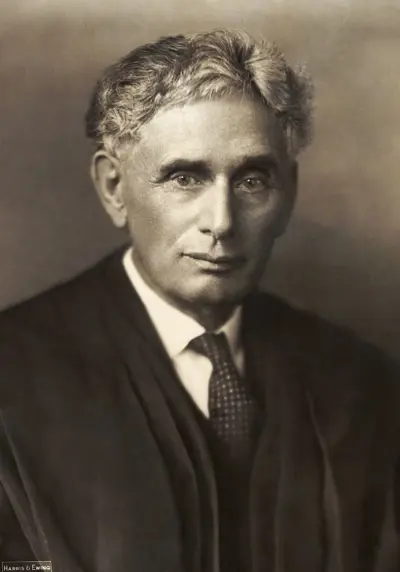
Louis Dembitz Brandeis was an American lawyer and associate justice on the Supreme Court of the United States from 1916 to 1939. He was born in Louisville, Kentucky, to Jewish immigrant parents from Bohemia (now in the Czech Republic), who raised him in a secular home. He attended Harvard Law School, graduating at the age of 20 with the highest grade point average in the law school's history. Brandeis settled in Boston, where he founded a law firm (that is still in practice today as Nutter McClennen & Fish) and became a recognized lawyer through his work on progressive social causes.
