Diane S. Sykes Quotes
The Court's legitimacy arises from the source of its authority - which is, of course, the Constitution - and is best preserved by adhering to decision methods that neither expand nor contract but legitimize the power of judicial review.

Judicial Review is the principle which allows a court—judges—to declare an act of the legislature or the executive improper and unlawful. It is a standard principle of American government yet it was not explicitly stated in the Constitution. Hence to some, there is a question about the legitimacy of Judicial Review itself. Many nations do not have it. Many people think it is the most important aspect of a democratic society as it provides a check on both the executive and the legislature.


One of the conundrums of our constitutional system is who has the last word as to what the Constitution means. Essentially it is the judicial branch headed by the Supreme Court. But there are those who believe that the current popular majority should have a say in what is or is not constitutional. If so the legislative branch should have the last word. Still others say that the President is the only person elected by ALL the people, so his opinion most reflects the will of the public. And then there are most who argue that the Constitutional system was created just to avoid the power of currently popular majorities, and the courts should decide based on the Constitution itself. So the statement has very little meaning except that Phillips thinks that the courts have too much power. Whoever gets to decide what is or is not Constitutional will be accused of being “over” the Constitution by those who don’t like the decisions. In our system, that is the courts.

Referring to the Brown v. Board of Education, the Topeka, KS, Supreme Court school desegregation decision:


Cummings was arguing against a Constitutional amendment. His alternative led to Roosevelt's court packing schema.


The Roosevelt administration had stemmed the tide of Hoover’s Great Depression but the nation had not yet recovered. The New Deal measures, most of which would be considered fundamental to good government 50 years later was being constantly thwarted by a Supreme Court with a strong arch conservative majority headed by James McReynolds, a virulent, overt, anti-Semitic racist, who hated FDR—see {616652} and {585241}. The situation was to many like that which existed before the Civil War when the Court rendered the Dred Scott decision that so harmed the nation. Frankfurter, not then a Supreme Court Justice, urged Roosevelt to do something lest the American Public lose all respect for the Court and our Constitutional system and have the nation harmed by not allowing reforms like child labor laws to go through. The court actually ruled by a narrow majority that the government could not pass laws making it illegal for 11 year old children to work in coal mines or factories. FDR attempted to add more justices turning the majority into a majority—“packing the Supreme Court”, but that politically backfired. Some of the reforms never went through while others needed Constitutional Amendments like the end to Prohibition.


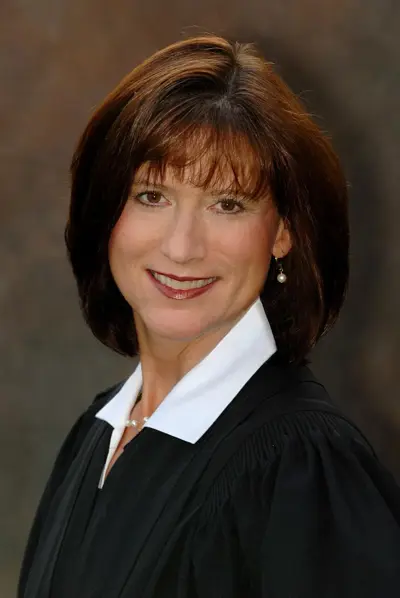
Diane Schwerm Sykes is an American jurist and lawyer who serves as the chief judge of the U.S. Court of Appeals for the Seventh Circuit. She served as a justice of the Wisconsin Supreme Court from 1999 to 2004.
