Frederick Douglass Quotes
The Constitution is a GLORIOUS LIBERTY DOCUMENT. Read its preamble, consider it purposes. Is slavery among them? Is it at the gateway? or is it in the temple? it is neither.
Douglass, Frederick. Oration, Delivered in Corinthian Hall, Rochester, by Frederick Douglass, July 5th, 1852. Lee, Mann & Co., 1852, p. 36.


There was a committee proposal to terminate the importation of slaves in 1800. There was a majority for this, but Mr. Randolph proposed that the time be extended to 1808, 20 years thence.


As a key member of Lincoln’s cabinet, William H. Seward was most concerned with preserving The Union. However, since the Constitution was written in 1787, there had been compromises made with the pro slavery forces of the South to give them proportionally more political power and to avoid interfering with the institution of slavery. The Dred Scott Supreme Court decision forced the Northern States to actively cooperate in enforcing and maintaining slavery. Large numbers of abolitionists had reached their limit and wanted no more compromises regarding slavery. Mrs. Seward was one of those. This quotation also illustrates the influence that some women had in politics even though women could not vote. Frances Seward was very much a political partner with her husband who was favored to beat Lincoln for the Republican Presidential nomination.


He was opposed to the existing Fijian constitution but could not muster enough political support to amend it. He therefore stated that he would ignore it. He was overthrown by a coup several weeks later. One provision that was particularly vexing to him was communal voting, which reserved almost two-thirds of the seats in the House of Representatives for persons registered on ethnic electoral rolls; this tended to polarize the nation and gave foundation to politicians with extreme views

The Federal Fugitive Slave Act required all in free states to assist owners of escaped slaves to return them to their owners. In 1854 a Missouri slave owner tracked his escaped slave to Wisconsin and the Federal officials incarcerated the slave pending his return. A Wisconsin mob broke the slave out of jail and helped him escape to Canada. Sherman M. Booth, Publisher & Editor of the Wisconsin Free Soil Democrat was convicted under the Fugitive Slave Act for aiding the escape. Smith’s opinion overturned the Fugitive Slave Act on the grounds that it had usurped state’s rights. The Supreme Court overturned Smith’s ruling, but Booth was pardoned. See {587926} & {587928}. The more “dread calamity” was civil war which of course came a few years later.

Liberia was founded by freed American slaves.


Southerners from the slave states wanted California to be admitted to the Union as a slave state. But a large majority of Californians saw that as a terrible alternative. It was argued that the Southern states would never vote to admit California if it were a free state (see {613404}) and in order to make it clear to the South that admission as a slave state was out of the question, this clause was passed at the Constitutional Convention.


The political machine of New York City, unlike most others in the Northeast were supporters of the Southern position on slavery. They had strong economic relations with the Southern planters and wanted to keep the federal government far away from state and local affairs.


The first Civil Rights Act {587712} was passed a few months before and has some of the same language as Congress wanted to make the laws very clear. The Southern Rebels who insisted on their right to have guns during Reconstruction, viciously denied that same right to the newly freed slaves. Sickles tried to remedy this, but the KKK and other terrorists intimidated most of the Blacks into not using the right that they had. Later, they would do that with the right to vote. In January, the Commanding General in charge of South Carolina had issued an order protecting the rights of Blacks to have guns {629894}. This law applied that to the entire country. The Southerners have always supported the 2nd Amendment except when Blacks wanted to have arms.

The Union troops had just been routed at Bull Run. Many in the North thought that the war would be a short one with little disruption of loss of life. Here Norton, like so many others, provided a a more realistic assessment. Also note the reference to “barbarism” in the South, When the Union was formed, the Southern states were not as well developed as the North from an industrial, educational or cultural perspective. There were vestiges of aristocracy, crude law enforcement, and much more poverty (Virginia excepted) than in the North. Most Northerners thought that the South would reform—modernize and become more like the North, but instead the gulf became greater as the North itself developed and changed rapidly while the South was mired in its traditions with their aristocracy gaining more political, economic and cultural control. This attitude of Northern superiority, objectively valid though it may have been, was sorely resented by the South and this resentment has persisted into relatively modern times.
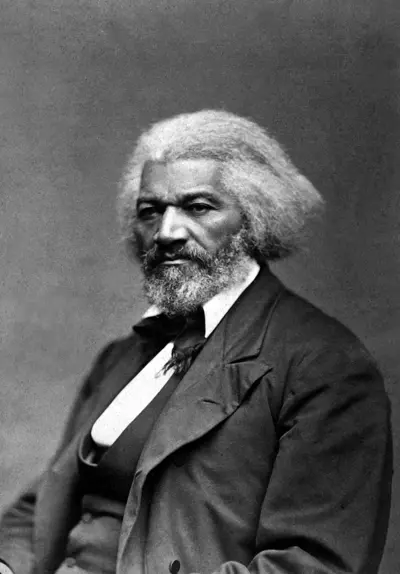
Frederick Douglass was an American social reformer, abolitionist, orator, writer, and statesman. After escaping from slavery in Maryland, he became a national leader of the abolitionist movement in Massachusetts and New York, becoming famous for his oratory and incisive antislavery writings. Accordingly, he was described by abolitionists in his time as a living counterexample to slaveholders' arguments that slaves lacked the intellectual capacity to function as independent American citizens. Likewise, Northerners at the time found it hard to believe that such a great orator had once been a slave.
