Richard Walther Darré Quotes
The concept of Blood and Soil gives us the moral right to take back as much land in the East as is necessary to establish a harmony between the body of our Volk and the geopolitical space.
Richard Walther Darré, 1895 –1953, German Reich Minister of Food and Agriculture, Nazi SS-Obergruppenführer, Quoted in "Ecofascism: Lessons from the German Experience" by Janet Biehl & Peter Staudenmaier
Sourced by: Eigen's Political and Historical Quotations

“Lebensraum” was a German expansionist concept of the time which has no good English translation. Literally, it means “living room”. The Germans had this notion that the German race and nation had to have more land to accommodate the growth of the German people. And because the Germans were a superior race, they were entitled to the land surrounding Germany in which to have Germans grow and thrive. The “inferior” peoples who lived on the land could be exterminated so that Germany would have this expansion room. The “Death’s Head units” were special German elite troops who used the Death’s Head as a symbol on their uniforms. Some of the Generals were concerned that the rest of the world would condemn Germany and possibly interfere if they exterminated the Poles. Hitler pointed to the example of the Turks who had killed most of the Armenians in the Armenian Genocide in the early 20th century. They got away with it with no outside interference, and there were no international consequences for Turkey. Hitler, convinced that the Armenian genocide was the precedent, thought Germany could easily get away with murdering the Gypsies, seriously handicapped, homosexuals, Russians, Poles and Jews. For other quotations on the Armenian Genocide, see {51838}, {638251}, {620602}, {620603}, {620604}, {620605}, {620600}, and {620606}

Literally the word means “living room” but was an intellectual doctrine which essentially said that Germany, in order to survive as a major civilized society, was justified in conquering the lands of its neighbors—especially those areas which had traditionally ethnic German populations. This conquest would give the German “master race room to expand.

This quotation is a good illustration of a practice that existed in the age of Empire where two or more large powers would agree among themselves as to which one of them had the right to seize a smaller power, not part of the compact.

His definition of Russian territory included any area that the Czars claimed which included Poland, the Baltic States, the Ukraine, the Caucuses, but at the time of the speech, Russia was fighting to keep its existing territory.


The meeting included several Indians, President Grant, and the Secretary of the Interior and the Director of the Bureau of Indian Affairs. The Indians had been offered $25,000 and land in the Oklahoma Indian Territory in exchange for moving from their traditional lands.

The statement was made in response to Senator Lewis Cass argument that “We want room.” There is an interesting parallel between Corwin, and American arguing for the Mexican side, and that of William Pitt, an Englishman who made an argument for the Americans during the American Revolution. See {626047}.

He was one of the first democratic politicians of Germany who argued for rapprochement between France and Germany and may have been the first to suggest a European Union. Most of the world was very distrustful of German nationalism, and Stresemann presented one of the positive aspects of it. He died of a stroke in 1929 and the political vacuum was eventually filled by Hitler and the Nazis as the Weimar Republic was short lived. As democratic as Stresemann was, he still was preoccupied with German territorial control. Germany’s aggression in WWI led to a peace treaty that fixed borders that were always contested by Germany. The German position was that if there was an area or France, Poland, or other country where there was a community of German speaking people, then that area should be a part of Germany. This was one of the main reasons for Germany’s aggression on WWII.

Nationalism produced negative effects on the society ranging from aggression, ethnic cleansing, war and hatred.

The Japanese have always been very race conscious seeing themselves as the racial pinnacle of Asian peoples and others as inferior. The peoples of Okinawa were not the racially pure Japanese and MacArthur turned out to be right that protection of Okinawan rights, prerogatives, and dignity was much less important than for ethnic Japanese. It would not be until the last decade of the 20th century that Japanese public opinion was seriously concerned about the Okinawans. Even then, Japan’s independence and dignity as a sovereign nation appeared more important than the rights and dignity of the native Okinawans.


Most of her modern admirers tend to repress this quotation which is very embarrassing for most modern conservatives. However, there is a minority of thinkers who maintain that land, unused, is open to anyone who will make use of it to improve civilization. Many conservationists, in contrast, extol unused land for preservation.
This statement was more than a proverb but a popular political doctrine as well which had for years destabilized the Balkans. From the Serbian point of view, if a Serbian family moved to Bosnia or another country, their family land and their decedents were Serbian and under the governance of Serbia. Where there were enclaves of Serbs, they and the Serbian Government considered that land Serbian. This attitude even widely prevailed into the 21st century and led to the U. S. War with Serbia over the Serbian attempts to control parts of neighboring countries where Serbs were in the minority. The Serbs were not unique in this respect. Germany, in WWI, had seized territory from France because there were large enclaves of Ethnic Germans in the Sudetenland. The Ancient Romans likewise asserted the protection of Roman Citizens anywhere in the known world.
The Hapsburgs were the ruling family of the Austrian Empire who wanted to invade Serbia in retaliation for their complicity in the assassination of the Austrian Archduke. This would likely bring Russia in the war in support of Serbia. The editor thought that there was no obligation to support Austria when they were planning a war of choice. What the editor did not know was that the German leadership very much wanted war at the time and supporting Austria was the perfect excuse to fight without them starting the conflict. However, the evidence became clear later than it was German aggression that turned the dispute into a World War.


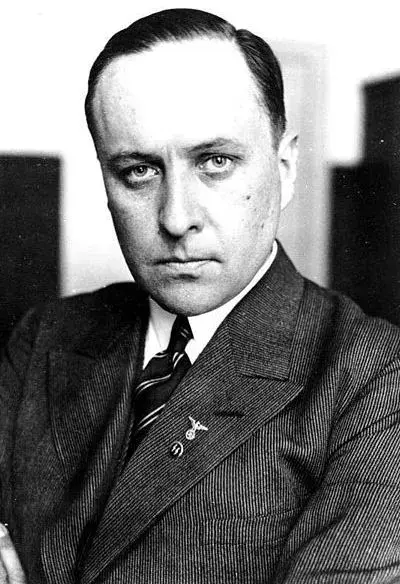
Richard Walther Darré, born Ricardo Walther Óscar Darré, was one of the leading Nazi "blood and soil" (German: Blut und Boden) ideologists and served as Reich Minister of Food and Agriculture from 1933 to 1942. He was a high-ranking functionary in the Nazi Party and the SS, and was the seventh most senior commander in that organisation.
