David Hume Quotes
The civil wars which arose some few years ago in Morocco between the Blacks and Whites, merely on account of their complexion, are founded on a pleasant difference. We laugh at them; but, I believe, were things rightly examined, we afford much more occasion of ridicule to the Moors. For, what are all the wars of religion, which have prevailed in this polite and knowing part of the world? They are certainly more absurd than the Moorish civil wars. The difference of complexion is a sensible and a real difference; but the controversy about an article of faith, which is utterly absurd and unintelligible, is not a difference in sentiment, but in a few phrases and expressions, which one party accepts of without understanding them, and the other refuses in the same manner.... Besides, I do not find that the Whites in Morocco ever imposed on the Blacks any necessity of altering their complexion ... nor have the Blacks been more unreasonable in this particular.
David Hume, 1711-1776, Scottish Philosopher & Historian, Quoted in Bernard Lewis, Race and Slavery in the Middle East
Sourced by: Eigen's Political and Historical Quotations


[This was the first Abolition appeal written by a Black Man. It was published in Boston and despite the fact that it was very critical of whites, was very popular going through two more printings within the next two years.]

Referring to Montgomery Alabama in 1950.


Billy Sunday was the most famous preacher of the day. Unlike the vast majority of white preachers, he not only preached to black audiences but exuded an atmosphere of friendliness and comfort around Blacks that amazed most. Most Black leaders thought Sunday was very good for race relations, but there were some clergy like Grimke who criticized him. Sunday was castigated by many racist whites for preaching to Blacks, but he did not go as far as to condemn or preach against racism and the discrimination of the day and he would not preach to an integrated audience. Grimke, in contrast, preached to an integrated congregation and was one of the few white clergy who did in the South. (Washington DC was then a southern, segregated city.) See {585415} for another critique of Sunday.


The Roman Catholic Church in America had a very difficult problem with slavery. Catholics were themselves a minoirty, hated and distrusted by many Protestants. In most of the country, the distrusr was based on their large immigrant population, but in the South Catholic theology was hated and the Vatican and Pope were particular targets. The Catholic Clergy generally did not want to take sides in the most contentious issue in America since its inception. The Southern Catholic Clergy did not have that option as in the South, anyone who was not a supporter of slavery was an "enemy of the community and subject to all kinds of violence." Some Southern priests were willing to take the personal risk but did not want to put their followers at risk. In a strange consequence, Catholics--especially Irish Catholics--fought on both sides of the Civil War and often against each other. While it was not an exemplary moral behavior for the Church, there were difficult pressures on Catholic leaders. Further, most of the lowest and most difficult, undesirable jobs were filled by Catholics and most Catholic laymen so and end to slavery as the start of pitting the Catholics against the Blacks. So there was not a groundswell for abolition in most Catholic parishes even in the North.

Incredibly enough, after the Civil War and emancipation, most Virginia leaders opposed any form of rights for Blacks with one of the major reasons being that they were ignorant and uneducated. It was actually a crime to teach even a free Black to read.

Througout political history, including in America, opportunistic, unscruplous politicians have appealed to the prejudices and hates of subsets of the population for others (usually minorities) to get elected or obtain support for legislation and administrative action. In America this has been an element of all populist movements—an enemy. This quote is particularly enlightening in that it shows that the real need is to have a minority to focus the public against—which one is not as material as the fact that there is one.

When the first Southern States seceded, each appointed a whose job it was to persuade the other Southern States to also secede. In this case Hale was marketing secession to Kentucky which with Maryland were the only two Southern States to reject what they regarded as treason and rebellion. The importance of the quotation however is in his argument which was all based on enmity to racial equality and abolition. Later Southern apologists would argue that the Civil War was fought, not about slavery and racism butt about different philosophies of government. See {623715} .

Jones, like many religious leaders at the time was an inveterate racist. He not only branded anyone advocating against segregation as “in opposition to God”. Jones also solicited the support of the Ku Klux Klan, and like many clerics would never condemn the KKK beatings, tortures, lynchings and murders.
This quotation illustrates one of the earliest major political dirty tricks. The pamphlet was published supposedly as a Republican campaign piece. The Democratic ploy was to turn votes from Abraham Lincoln to the Democratic candidate, George B. Mclellan. It also appears to be the first English usage of the word “miscegenation”. Lincoln was re-elected in spite of the Republicans being portrayed as radical race mixers.
This quotation and the so called “facts” therein have been quoted by many to demonstrate general racial inferiority of Blacks as compared to whites in the first half of the 20th century. There are two difficulties with their arguments. First it has been scientifically demonstrated that amongst many animals including humans brain size has nothing to do with intelligence. For example, the primitive Neanderthal man had a bigger skull and brain than modern man. Second, it is not the case that Negro brains are smaller than whites. Stephen J. Gould has demonstrated the fallacy of these early studies showing the difference. It is a classic scientific example that researchers looking for a particular solution will often find it whether or not it is real.

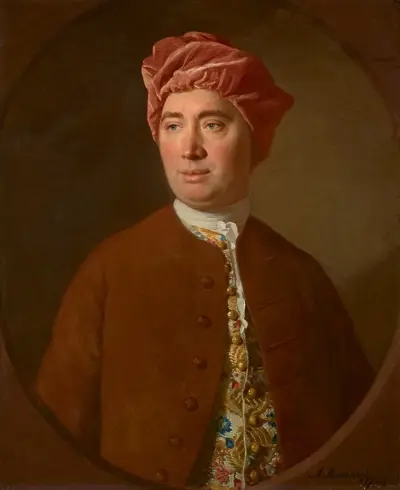
David Hume, Hume strove to create a naturalistic science of man that examined the psychological basis of human nature. Hume argued against the existence of innate ideas, positing that all human knowledge derives solely from experience. This places him with Francis Bacon, Thomas Hobbes, John Locke, and George Berkeley as a British Empiricist.
