Harry S. Truman Quotes
The civil servant, the general or admiral, the foreign service officer has no authority to make policy. The act only as servants to the government and therefore they must remain in line with the government policy that is established by those that have been elected by the people to set that policy.
While this is so in theory, both legislative and executive elected officials often abdicate their responsibility to set policy to the civil servants and Pentagon brass who write the regulations, and interpret the laws and Executive orders. In modern government, there are so many policies that need to be made that Congress and the President and Cabinet often don’t even know the issue exists much less what the national policy is. The Congress and President can choose to make specific policy on whatever they wish, but the Civil Servants as a de facto matter end up making the rest of the policy decisions. When there is Congressional gridlock, Congress can’t make very many policy decisions, so ironically, the civil servants and Pentagon brass make even more of the polices of the government.
Harry S Truman, 1884-1972, 33rd President of the United States (Democrat, MO), Years of Trial and Hope
Sourced by: Eigen's Political and Historical Quotations


Periodically in American history, there has been a struggle between the Executive Branch and the Senate for dominance. The Senate’s power is negative however. It can block things, but cannot directly make them happen. The President can do both.


In general, Justice Jackson was correct. Almost all major Supreme Court decisions that have ruled against the Legislative Branch or the Executive Branch, have been, reversed by a future Supreme Court, reversed by new legislation, reversed by a subsequent Constitutional Amendment, reversed by science or technology, or acknowledged by future generations to be wrong but were now moot and needed no correcting. The greatest of the Supreme Court decisions have generally been those that upheld the Congress and the Executive.


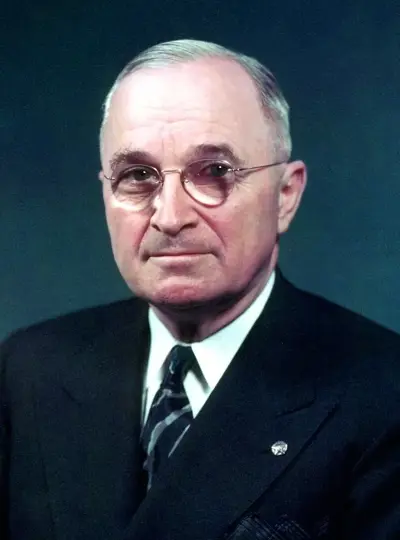
Harry S. Truman was an American politician who served as the 33rd President of the United States (1945–53). He served as a United States Senator from Missouri (1935–45) and briefly as Vice President (1945) before he succeeded to the presidency on April 12, 1945 upon the death of Franklin D. Roosevelt. He was president during the final months of World War II, and approved the plan to drop atomic bombs on Hiroshima and Nagasaki. Truman was elected in his own right in 1948. He presided over an uncertain domestic scene as America sought its path after the war and tensions with the Soviet Union increased, marking the start of the Cold War.
