Theodore Roosevelt Quotes
Oh, if only I could be President and Congress, too, just for ten minutes.
Morris, Edmund. Theodore Rex. Random House, 2001, p. 317.

Since Theodore Roosevelt, the Presidency has become stronger and Congress weaker. The original idea of the framers of the Constitution was to have three co-equal branches of government. However Gingrich was so partisan on this point that he lost most of his credibility and lost his position of leadership in the House. He was constantly asserting the power of the House against Democratic President Bill Clinton while he never had when Republican George W. Bush was President. His house impeached President Clinton on charges emanating from Clinton’s sexual foibles and effort to keep his predilections secret. This not only impeded government for a long time, but angered the public. In the end the Republican Controlled House could not even get a majority of the Republican controlled Senate to vote against Clinton, much less the super-majority the rules required. Ironically, by the second term of George W. Bush’s administration most members of Congress and the American public had thought the Presidency had gotten to powerful relative to Congress and Gingrich’s objective became a national one, but Gingrich himself had been discredited and was completely out of office.


The Chairmen of the Committees then had tremendous, almost unilateral power. The chairman reached seniority by being elected over and over and had little opposition. At the time they were almost all older Democratic Congressmen from the "Solid South", very conservative and still racists despite the 1964 Civil Rights Act. They were outraged when a Freshmen member of Congress who rarely made a public statement, took on the most powerful members of the House and wanted to reform the Seniority. But Ms. Chisholm was a teacher in her professional life, and by challenging the seniority system and attracting the enmity of most of the Chairmen, the media and the public started to cover the dispute and Chisholm explained to America exactly how the system worked and how undemocratic and racist it was. Her effort put the Seniority System on the public agenda, and reforms evolved over the next decades." She was the first Black woman to be elected to Congress and was the first Black woman to actively campaign for the Presidency


Alberto Gonzalez, White House Counsel and later Attorney General who was forced to resign and David S. Addington, Counsel to the Vice President, had come up with a novel view of the powers of the presidency. They argued that since the President is the Commander in Chief, in a war situation or intelligence gathering thereto, has the Constitutional responsibility for that function, he need not obey any laws of Congress as in the conduct of the war Congress would be impinging on the Constitutional separation of powers which itself was prohibited by the Constitution. The argument did not find any significant legal support but for a while the George W. Bush White House behaved as if this were the law, despite the fact that even in the American Revolution and the War of 1812 Congress passed laws regulating the conduct of the armed forces as is provided for in other parts of the Constitution. Yet even Goldsmith would allow the President some powers that many think are unconstitutional and/or belong to Congress. See {32436}.


To Mises, “interventionism” is any government action that affects business and businessmen and women. In a large complex society, virtually every government action will benefit some more than others while harming some more than others. There are almost always winners and losers as a result of every government action. Most political philosophers see justice and fairness in benefitting the majority of people most of the time. However Mises and others observe that in a large complex society, in an absolute sense, politics and government can never be fair and just to all.

Periodically in American history, there has been a struggle between the Executive Branch and the Senate for dominance. The Senate’s power is negative however. It can block things, but cannot directly make them happen. The President can do both.

This is a very important historical quotation because it clearly stated the left wing view of regulation. Large Business had been so unethical and illegal at the time that the majority of Americans and Congress, together with a Republican President, thought that it would be good to “weld” the growth and development of large companies to the Government. The right wing saw this as extreme Communism. Over time, when corporate greed and excesses had been controlled by government and was not as prevalent, the inhibition on growth and development of welding corporations to Government was recognized and a period of deregulation followed with most Americans not wanting to allow large companies to be completely deregulated and also not wanting them welded to the government. The extent of regulation has been the political contest with the extreme left and extreme right still holding to their ideological positions and sometimes paralyzing the middle as in the Obama administration.


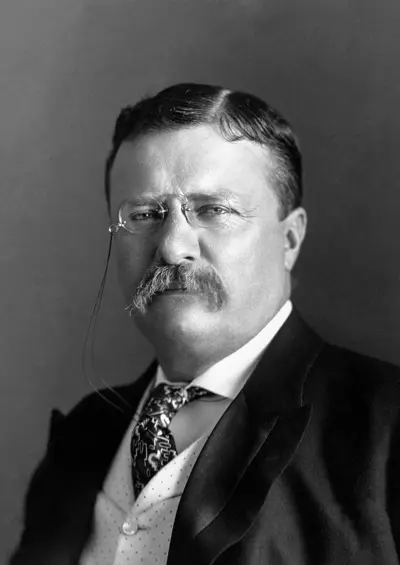
Theodore Roosevelt Jr., often referred to as Teddy or his initials T. R., was an American statesman, conservationist, naturalist, historian, and writer, who served as the 26th president of the United States from 1901 to 1909. He previously served as 33rd governor of New York from 1899 to 1900 and the 25th vice president of the United States from March to September 1901. Roosevelt emerged as a leader of the Republican Party and became a driving force for anti-trust and Progressive policies.
