Saadi Quotes
The children of Adam, created of the self-same clay, are members of one body. When one member suffers, all members suffer, likewise. O Thou, who art indifferent to the suffering of the fellow, thou art unworthy to be called a man. بنى آدم اعضای يك پیکرند که در آفرينش ز یک گوهرند چو عضوى به درد آورد روزگار دگر عضوها را نماند قرار تو کز محنت دیگران بی غمی نشاید که نامت نهند آدمی
This quotation was used by Aga Kahn III in his famous speech to the League of Nations, October 6, 1937. It speaks of the unity of the Muslims, Jews and Christians from an Islamic scholar of the 13th Century.
Saadi, 1184- ~1283, (Mosleh al-Din Saadi Shirazi), Persian Islamic Scholar & Poet, Bani Adam
Sourced by: Eigen's Political and Historical Quotations


The “People of the Book” were the Jews and Christians who received special status in Muslim lands and societies. Despite the enmity and Muslim fundamentalist terrorism of modern times, Jews have historically lived in relative harmony in Islamic lands, and with the exception of the Christians in the Crusades, Christians were also given a place in Muslim societies. The “Book” refers to the Bible.

See {618216} for a seemingly contradictory quotation by White.
This is the Islamic version of the Golden Rule.


Lebanon is a country divided into religious sects which have a long history of animosity, distrust, violence among them. Few leaders were as candid as Jumblatt.
The people of the Book refers to Jews and Muslims. This passage of the Koran is used to justify ecumenism with Muslims integrated with Jews and Christians. The Koran consists of Muhammed’s sayings, and he himself had opinions about Jews and Christians that differed from time to time. So although this passage signals a tolerant religion, in other places Muhammed preached violence against the people of the Book. At first Muhammed and his followers expected to see the people of the Book adopt Islam as their religion. When they did not, relations deteriorated somewhat.


This statement by The Prophet has been interpreted by Muhammad Abduh and other Islamic modernists and reformers as a call for co-existence and common ground between Muslims on the one hand and Christians and Jews on the other. However, some Muslim extremists interpret this sura to mean that the call is for the Christians and Jews to accept Islam and THEN there will be common words. There is in modern times, there is no Islamic Hierarchy like a Pope to make a definitive determination about such an interpretation so Muslims are split on the interpretation. In that sense Muslims today are like Protestants, Jews and Buddhists.

Toleration is a relative term. The Muslim Moors made Christians (and Jews) pay a special tax. At times they were forced to wear special clothing so that they could be readily identified. And they could not build churches larger or taller than the smallest mosque in the community. At times, their occupations were restricted but at other times Christians and Jews were appointed to the highest positions like Vizier. The Inquisition, in contrast, forced all Muslims (and Jews) to leave the country without any of their property or money or be tortured and killed—usually by burning at the stake unless of course that they converted to Christianity.


He led an Islamic rebellion against the Quinn Dynasty which ended in his beheading in 1873. Since the Christians were also a minority, he tried to form an alliance with them. Hatred of Christians is not endemic to Islam—politics affect the situation also. His tomb is shown in the graphic.


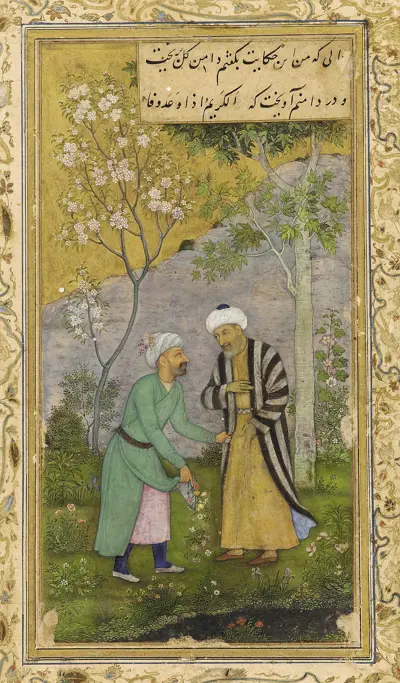
Abū-Muhammad Muslih al-Dīn bin Abdallāh Shīrāzī (Persian: ابومحمّد مصلحالدین بن عبدالله شیرازی), better known by his pen name Saadi (/ˈsɑːdi/; Persian: سعدی, romanized: Saʿdī, IPA: [sæʔˈdiː]), also known as Sadi of Shiraz (سعدی شیرازی, Saʿdī Shīrāzī; born 1210; died 1291 or 1292), was a major Persian poet and prose writer of the medieval period. He is recognized for the quality of his writings and for the depth of his social and moral thoughts. Saadi is widely recognized as one of the greatest poets of the classical literary tradition, earning him the nickname "The Master of Speech" or "The Wordsmith" (استاد سخن ostâd-e soxan) or simply "Master" (استاد ostâd) among Persian scholars. He has been quoted in the Western traditions as well. Bustan has been ranked as one of the 100 greatest books of all time by The Guardian.
