William Jennings Bryan Quotes
The brute theory [evolution] has paralyzed the influence of many of our preachers and undermined the faith of many of our young people in college.
William Jennings Bryan, 1860-1925, U. S. Secretary of State, U. S. Congressman (Democrat, NB), 3 Time Unsuccessful Democratic Presidential Candidate, 1923
Sourced by: Eigen's Political and Historical Quotations


Here the Governor makes a very common error of people who do not have scientific training. They believe that a Scientific Theory is an assertion that has not yet been proven. That is not the way scientists use the term. The Theory of Relativity, Theory of Quantum Mechanics and Theory of Evolution all scientifically refer to a major set of scientific statements and relationships that have been proven over and over again, together with many corollaries and deductions. It is an established, experimentally proven body of knowledge that is still producing additional hypotheses that then need to be proven or refuted. The scientific THEORY is as high as it gets on the scientific scale of proof. The word “theory” used in science is not one fact, but a large set of related facts and their proofs. What the Governor refers to, scientists call hypotheses or speculations. There have been many more proofs of evolution -–many thousands of them—than proofs of Relativity which is actually harder to prove and only has a few thousand proofs. More important, not one person has ever been able to prove scientifically that any of the assertions of evolution are false. Some religions have no difficulty with evolution (Roman Catholics for example) and a few do (fundamentalist Protestants for example). Governor Huckabee was also a fundamentalist Protestant minister. Even the Federal courts have held that the objections and so called “refutations” and alternatives to evolution are religious and not scientific, and hence may not be taught as science in public schools. Non evolution (like creationism) is a religious and cultural notion and should be studied as that.


There are many scientists who disagree with Johnson’s very unusual logic. They point out that it is certainly possible that God initially did not have had humans in minds, and when they evolved, decided that they were worthy of salvation history and then interfered to the extent of a virgin birth. Others would point out that just because man cannot exactly foresee the exact future pattern of evolution, does not men that a Supreme Being could not have initiated the mechanism that he/she knew would result in salvation history. The Pope and the Catholic Church see no inconsistency between Darwinism and the salvation history. Then there are those non-Christians who do not believe that God ever did introduce salvation and there are many more of them than there are Christians. Then, it is possible that God just set things in motion and had more important things then micromanaging evolution on our one planet in a universe of billions of billions. Last there are those who do not believe that there is or has been a God. Of course there is the possibility that Johnson is right, and religiously he may be, but that is not subject to scientific analysis.

Conflict between religion and evolution does not exist in most churches. There are exceptions of some orthodox Jews, fundamentalist Christians and Muslims. However, in this case the highest prelate of the American Episcopal Church not only sees no conflict but urges that evolution be taught in schools.


The Pope went on to state that Evolution was consistent with Roman Catholic doctrine, changing a position that had been taken by the Catholic Church and many fundamental protestant denominations. A few actually still reject evolution even after all the evidence and proof of the basic Darwinian theses. There is nothing in evolution that per se denies the existence of God or even that God created the universe and the mechanism of evolution. That is why the Catholic Church and so many Protestant Churches, Judaism, Buddhists, and so many other religions have no theological problem with evolution. Those religious groups who have difficulty with evolution are those fundamentalists (Protestants, Jewish and Muslims) who believe in the literal truth of Holy Scripture. They also assume that God designed each particular plant or animal species. Other religions hold that it was God who created the mechanism of evolution and that is how all the species developed and are developing today. Some religious evolutionists believe that evolution is God’s mechanism for perfecting man.


At the time, it was very difficult for people who had been taught all their lives that God was directly responsible for the creation to accept the notion of evolution. At the time, there was not the overwhelming evidence proving Darwin’s theory that we have today. Nor did theologians realize that evolution and Darwinism were not inconsistent with the concept of a creator and supreme being. Nonetheless, there are still those who, like Agassiz, reject evolution and insist that the Biblical version of creation is literally true. See {586990}. Then there are people who have come up with the concept of Intelligent Design which originated with Agassiz though he never called it that. Most religious people today, in contrast, see no conflict in natural selection as described by Darwin and later proven, and the concept of God. They see the Biblical creation as metaphorical and natural selection as the product of an omniscient supreme being.
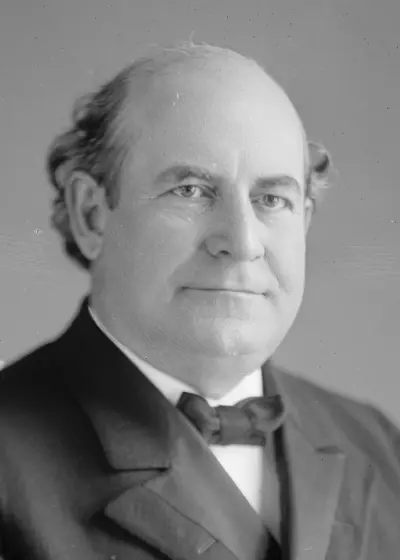
William Jennings Bryan was an American orator and politician from Illinois and Nebraska. Beginning in 1896, he emerged as a dominant force in the Democratic Party, running three times as the party's nominee for President of the United States in the 1896, 1900, and 1908 elections. He also served in the United States House of Representatives and as the United States Secretary of State under Woodrow Wilson. Because of his faith in the wisdom of the common people, he was often called "The Great Commoner".
