Pankaj Mishra Quotes
The British Empire passed quickly and with less humiliation than its French and Dutch counterparts, but decades later, the vicious politics of partition still seems to define India and Pakistan.
Mishra, Pankaj. "Exit Wounds." The New Yorker, Condé Nast, 13 Aug. 2007.


Churchill was reported to be so angry and exasperated that his face turned red and he was sputtering. During World War II, Gandhi, Nehru and other Indian Nationalists were leading protests against British control of India. This not only bogged down British soldiers surprising the nationalists rather than fighting in Burma or in other war theaters, but India supplied a huge number of battalions to the British Army the world over and if that manpower dried up, the allied war effort would suffer. The American State Department wanted Churchill to announce that after Japan was defeated, there would be a process toward self-government. This way, they thought, the Indians would redouble their effort to defeat the Japanese and stop the then current protests and strikes. Churchill was strongly opposed to any diminution of the British Empire, but beyond that, he knew India quite well and realized that at any hint of Independence the large Muslim minority in India would insist on autonomy or a partition of the country and use sectarian violence and terror to intimidate the Indian Congress party and the British, but the major victims of the terror—the Hindus and the Sikhs would not remain passive, but would retaliate in kind. President Roosevelt was in the midst of planning the Normandy Landings of the D-Day invasion and did not want to pressure Churchill and the British at this point in time, so the door to independence was not opened during the war and Britain had to deal with the protests throughout. However, when, after the war, the Labor Government, started a process toward Indian independence which resulted in exactly what Churchill predicted. At least 2 million Indians were slaughtered in the internecine terrorist cycles of fear and retaliation motivated terror attacks what were so extensive that the British military could not really control it.


Singh turned him down. Note that even before Pakistan was a country, Jinnah and other Muslim leaders had hopes of grabbing much of India as the British partitioned it, and have been trying to do so ever since the inception of Pakistan

A 'kirpan' is a type of knife—a weapon—which all male Sikhs are religiously obligated to have in his possession and on his body at all times. Singh was a Sikh Maharaja (King) of an area that had about an equal number of Muslims and Sikhs. The Sikh's had a long history of living under Muslim domination and wanted no part of any more. Patiala was within the Punjab and Jinnah was insisting that the Punjab should be a Province of the new Pakistan because the Punjab was majority Muslim. However, there were many Sikhs, as well as some Hindus, Buddhists, and Christians and virtually none of these wanted to be a part of Pakistan. Further, a significant portion of the Muslim Punjab population also preferred to join India for many reasons, not the least of which was that they had become used to a democracy where they had complete freedom of religion and civil rights as well, and with the exception of Turkey none of the Muslim countries were democratic. Based on the history, actions, inactions, and statements of the Muslim League which did not democratically elect its leaders, Pakistan would not likely be a democracy that guaranteed civil rights—especially religious rights—to their citizens (and they were right). So the majority of the people of the Punjab were opposed to becoming a part of Pakistan. The Sikhs were passionate opponents of being a part of Pakistan as they knew their Muslim neighbors one of whose major reasons for wanting a Muslim state was that everyone could then be forced to be Muslim or be expelled or ethnically cleansed.
The Partition was accompanied by over 2 million murdered Indians as India was divided into a smaller India with almost all the Hindus and Sikhs and a slight majority of the Muslims and Pakistan with all Muslims who made that choice. Pakistan has been trying to de stabilize the area ever since to gain control of more land and became a theocracy and military dictatorship—sometimes de facto and sometimes de juro.
As early as 1933, 14 years before Indian independence, there was a movement for a separate Muslim nation within India. Ironically, Hindu India was never a nation in any sense of the word, but was a series of independent principalities much like Italy before its unification. However, with the Muslim conquest of the various Indian states, there was a central authority, ruler, and nation for the first time. Later the Muslims had to argue that India was not a country when it was they who had made it such. When the Muslim Emperors were in power, they argued that India was one country under their authority. But when they lost power, the Muslims argued the other side of the issue.


This quotation is an excellent example of the early, militant Gandhi. It is typical of militant theocracies of the Islamic world today.
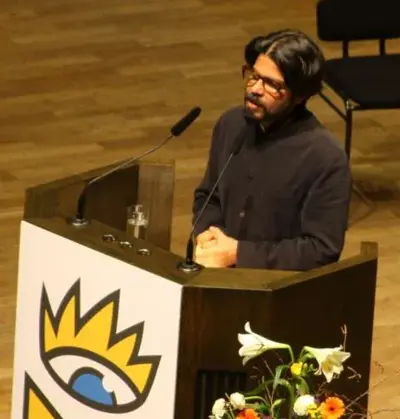
Pankaj Mishra is an Indian essayist and novelist and a recipient of the 2014 Windham–Campbell Prize for non-fiction.
