Carter G. Woodson Quotes
The author takes the position that the consumer pays the tax, and as such every individual of the social order should be given unlimited opportunity to make the most of himself.
Woodson, Carter G. The Mis-Education of the Negro. Associated Publishers, 1933.


A tax system should be instituted

FDR had as usual been attacked by the Chicago Tribune and other conservative newspapers. His assistant Raymond Moley drafted the response.

This was written at a time when the George W. Bush Administration was pushing tax cuts and running very large deficits to do it. Most people presumed that the rich were big supporters of the tax cuts but Bill Gates, then the richest man in America, and Buffett, the second richest, were both in favor of higher taxes.

An income tax had been instituted during the Civil War but had lapsed. Existing taxes were all excise or head taxes—very regressive. Later there was a political movement to bring back the income tax with the intention of taxing all income equally. There was a titanic struggle which culminated in a Constitutional Amendment allowing the income tax. None of the original politicians, for or against, the income tax could never imagine an income tax that would charge lower rates for investment income. That was the entire purpose of the income tax at the beginning—to tax investment (unearned) income. The “capital gains tax” was the creative way of the rich getting back some of what they thought the lost when the income tax was instituted.

whether or not to buy luxuries This quotation and {639885} together illustrate why it is so difficult to classify historical politicians in the left-right categories of a future time. Here Gogel seems a strong liberal arguing for progressive taxation and luxury taxes, and tax relief for the poop, while in {639885} he sounds like a 21st century extreme conservative.
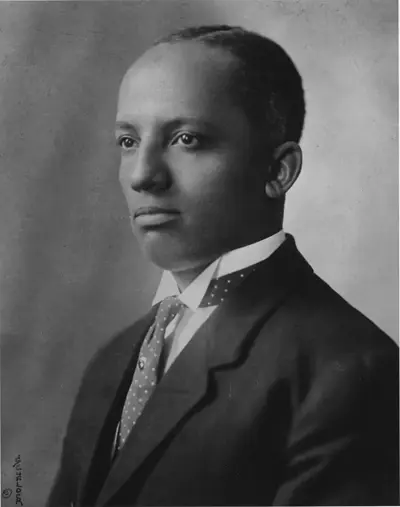
Carter Godwin Woodson was an American historian, author, journalist, and the founder of the Association for the Study of African American Life and History. He was one of the first scholars to study the history of the African diaspora, including African-American history. A founder of The Journal of Negro History in 1916, Woodson has been called the "father of black history". In February 1926 he launched the celebration of "Negro History Week", the precursor of Black History Month.
