Lucy Stone Quotes
The anti-slavery cause had come to break stronger fetters than those that held the slave. The idea of equal rights was in the air. The wail of the slave, his clanking fetters, his utter need, appealed to everybody. Women heard. Angelina and Sara Grimki and Abby Kelly went out to speak for the slaves. Such a thing had never been heard of. An earthquake shock could hardly have startled the community more. Some of the abolitionists forgot the slave in their efforts to silence the women. The Anti-Slavery Society rent itself in twain over the subject. The Church was moved to its very foundation in opposition.
This was her last public speech.
Lucy Stone, 1818-1893, Founder, National American Woman Suffrage Association, Founder, Women's Journal, Speech to the Congress of Women, The Progress of Fifty Years, World’s Fair, 1893
Sourced by: Eigen's Political and Historical Quotations


The Bible and the Church have been the greatest stumbling blocks in the way of women’s emancipation.
The most important documents and doctrine of most churches were created by men who also established the framework of the religion. The result has in almost all cases been a sexist structure with women having not only little power not typically females are banned from all church governance. See {640303} for her quote on religion in general vis a vis women.


She was overly optimistic. She would be dead for 30 years before women got the vote and some would argue that full equality has not been reached yet.


Fitzhugh was a Southern iconoclast whose view of Northern labor was much like that of Karl Marx but who was an enthusiastic supporter of slavery. Fitzhugh was of the opinion that slavery would be reinstated in the North and his treatise agues for that. More and more intellectual opinion was coming to the conclusion that slavery must be abolished or made universal before Lincoln’s famous statement in his debate against Douglas. Although Northerners and Southerners had come to agree on this point, they disagreed about which alternative would and should prevail.


Grimke was an amazing orator once speaking for 6 successive evenings at the Boston Opera House. Some male abolitionists suggested that she should not speak publicly because a female speaker might offend some in the audience.


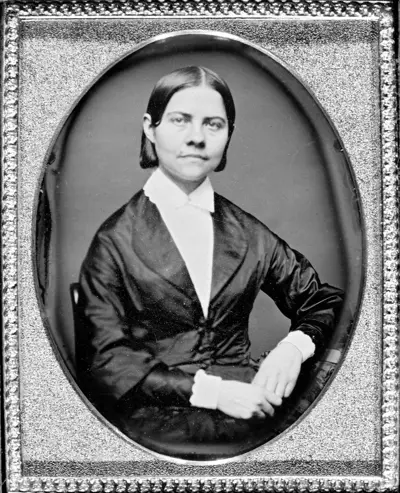
Lucy Stone was a prominent U.S. orator, abolitionist, and suffragist, and a vocal advocate and organizer promoting rights for women. In 1847, Stone became the first woman from Massachusetts to earn a college degree. She spoke out for women's rights and against slavery. Stone was known for using her birth name after marriage, the custom being for women to take their husband's surname.
