Carl Schurz Quotes
The animosities inflamed by a four years' war, and its distressing incidents, cannot be easily overcome. But they extend beyond the limits of the army, to the people of the north. I have read in southern papers bitter complaints about the unfriendly spirit exhibited by the northern people — complaints not unfrequently flavored with an admixture of vigorous vituperation. But, as far as my experience goes, the "unfriendly spirit" exhibited in the north is all mildness and affection compared with the popular temper which in the south vents itself in a variety of ways and on all possible occasions. No observing northern man can come into contact with the different classes composing southern society without noticing it. He may be received in social circles with great politeness, even with apparent cordiality; but soon he will become aware that, although he may be esteemed as a man, he is detested as a "Yankee
Carl Schurz, 1829-1906, U. S. Senator (Republican, MO), Report on the Condition of the South (1865)
Sourced by: Eigen's Political and Historical Quotations

For years after the Civil War, many Southerners blamed the negative manifestations of the war on the wicked Yankees, rather than look to their own actions of starting the war and prosecuting it long after it was clear that they could not win.

This quotation is important because it is one of the few judgments and predictions Lincoln made that turned out to be very wrong. Even into the 21st century there are Americans with bad feelings and hostility about the Civil War.

The letter was also published in the Charleston Mercury, February 13, 1861


The South had attacked Fort Sumter

The amendments failed as did the compromise.

The American Civil War was followed by intellectuals throughout the world. Most were offended by the immorality of the slavery that the South was fighting to maintain, but admired the way they organized and fought for their principles.


Committee of the Congress. This was the prevailing Congressional and public view except for the South which had coalesced around an intellectual rationalization. See {618013}.
See Mark {606304}; also Matthew {606727}. Lincoln had used the “house divided” biblical metaphor in 1843 when arguing for Whig solidarity. The first political use of the Biblical metaphor and quotation with respect to American slavery appears to have been by Sam Houston in 1850 {603970}. The first use with respect to American slavery was byMassachusetts abolitionist, Edmund Quincy, in 1852. The second sentence of this famous quotation was forsaged earlier. See Lincoln, {619494} & {584918}. Also See Felix Rohatyn who used the Lincoln line to refer to poverty: {70611}.

Note the language used for abolitionists in the years leading up to the Civil War. American voters at that time had always lived with the institution of slavery in America and many thought of it as an institutional pillar of the American nation. Those who wanted to bring down an American institution were “fanatics”. Generally this world is used to describe true fanatics and reformers who want to change anything that has been in existence a long while. To paraphrase Edwin Newman, What words shall we use to describe the zealot who wants to destroy the country when every person who wants to improve and change a facet of our system is called a “fanatic.”

Sherman had friends in the South and he saw rebellion and war coming. Most Southerners had a romanticized view of war and were so wrapped up in trying to preserve their economic and cultural way of life that they did not think through the implications of such a war. After and during the war, Sherman was particularly angry with the Southerners who had brought such terrible casualties and destruction upon the land and its people and he was the leader of the March through Georgiam the most effective and humiliating campaign against the South.

Buchanan us considered by most historians to have been the worst or one of the worst Presidents of the United States. At this point, he was a lame duck president with Abraham Lincoln, the President Elect soon to take office. This speech, just encouraged the South more than ever and helped to bring about the Civil War. His vacillation and lack of any leadership on the slavery question exacerbated the polarization that was tearing the nation apart.

He may well have been right if the South had capitulated. But that is exactly what happened when they did not and were beaten. So the worst that the South could have ended up with by not following Vance’s view would be what they ended up without the many deaths and wounded and the massive destruction of property that took place in the latter part of the war.
The early Union military leadership was so poor and timid that it was not clearly demonstrated that a Confederacy was not viable until later in the war, and the Southerners possessed an extraordinary capacity for ignoring reality and self-delusion, that it was not demonstrated until Grant’s major victories and Sherman’s March through Georgia and the Southern East Coast that an independent South was not going to be.
He was a realist who foresaw that even though the South had been militarily defeated, there were those who would persist in their efforts to retain slavery or a de facto form where freedom is the form but subjugation was the substance. It would be Jim Crowe and terrorism in the form of the KKK and a successor to Lincoln who was very sympathetic to the aims and culture of the Southern Rebels.


President Andrew Johnson had been impeached by the House of Representatives and was being tried in by the Senate. A majority of the Senators voted for conviction but the vote was 1 short of the two-thirds that were needed. Johnson remained in office.

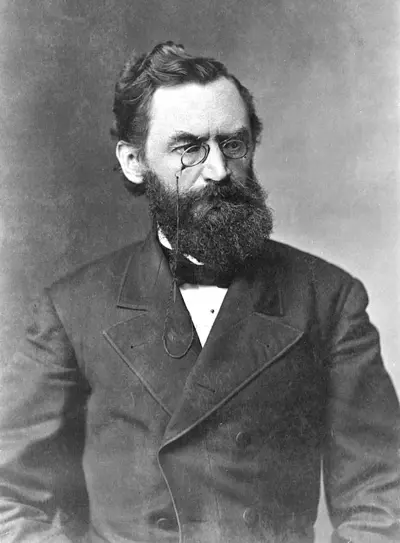
Carl Christian Schurz was a German revolutionary and an American statesman, journalist, and reformer. He immigrated to the United States after the German revolutions of 1848–49 and became a prominent member of the new Republican Party. After serving as a Union general in the American Civil War, he helped found the short-lived Liberal Republican Party and became a prominent advocate of civil service reform. Schurz represented Missouri in the United States Senate and was the 13th United States Secretary of the Interior.
