Franklin Pierce Quotes
I believe that involuntary servitude, as it exists in different States of this Confederacy, is recognized by the Constitution. I believe that it stands like any other admitted right, and that the States where it exists are entitled to efficient remedies to enforce the constitutional provisions .... I fervently hope that the question is at rest, and that no sectional or ambitious or fanatical excitement may again threaten the durability of our institutions or obscure the light of our prosperity ...
Note the language used for abolitionists in the years leading up to the Civil War. American voters at that time had always lived with the institution of slavery in America and many thought of it as an institutional pillar of the American nation. Those who wanted to bring down an American institution were “fanatics”. Generally this world is used to describe true fanatics and reformers who want to change anything that has been in existence a long while. To paraphrase Edwin Newman, What words shall we use to describe the zealot who wants to destroy the country when every person who wants to improve and change a facet of our system is called a “fanatic.”
Franklin Pierce, 1804-1869, 14th President of the United States (Democrat, NH), Inaugural Address, March 4, 1853
Sourced by: Eigen's Political and Historical Quotations

When the first Southern States seceded, each appointed a whose job it was to persuade the other Southern States to also secede. In this case Hale was marketing secession to Kentucky which with Maryland were the only two Southern States to reject what they regarded as treason and rebellion. The importance of the quotation however is in his argument which was all based on enmity to racial equality and abolition. Later Southern apologists would argue that the Civil War was fought, not about slavery and racism butt about different philosophies of government. See {623715} .

In June of 1850, a bipartisan group of Southern politicians met in Nashville, TN for the purpose of organizing strategy and tactics to ward off and defeat the growing aggressiveness of Northern politicians and other leaders in trying to abolish slavery. They issued an address to the people. This is one of the clearest statements of the position of most of the Southern Politicians on the increased efforts to abolish or curtail slavery. They felt that a deal had been made by the founding fathers and the first Congress not to deal with the slavery issue, and that deal must be honored in perpetuity. Most Northerners agreed that a deal had been made, but it was not binding forever—that a Congress could not limit the scope of a future Congress except via a Constitutional Amendment. The deal on Slavery was a deal not to address it for a while. It was not a deal to accept the Southern point of view. And none of it was written into the Constitution because opinion was even then split and a majority could not be mustered for a compromise that would write legal slavery into the Constitution. But many Southerners believed that its absence implied that it could not be addressed by the government. They demanded the right of their states to choose slavery if they so wished. Time was not on the side of the South and the Southerners who insisted on State’s Rights regarding slavery opposed States Rights for Northern States who wished to disallow fugitive slaves to be returned to owners. The more fugitive slaves there were, the more hypocritical the Southern position became as they needed Federal preemption on the issue of Fugitive Slaves, else slavery would end by escape and non-return of slaves.

This proposed Constitutional Amendment was debated just before Abraham Lincoln would take office. The South wanted to tie his hands on the Slavery issue, and wanted to end what had become a constant polarized Congressional debate over slavery. Of course, their idea of ending the debate was to Constitutionally prohibit further attempts to outlaw or otherwise interfere with slavery in the Southern states. A number of Northern members of Congress voted for it realizing that there was little or no chance of obtaining the ratifications of ¾ of the states and they wanted to buy some time for the Southerners to calm down over their fear of Lincoln and his upstart Republican party. The Amendment never obtained the needed votes though a few states did ratify it. Secession and the Civil War mad the amendment moot. The Southern position was so rigid, that they would compromise in no way on the slavery issue, and ended up of course losing more than they ever thought was possible by succeeding. Another reason this proposed amendment is historically important, is that it is yet another strong piece of evidence that the issue of the Civil War was slavery and not differences in political and economic philosophies as many Southerners have claimed since then. If States Rights in general were the great concern, would have been no reason to single out slavery if it were not the major issue. Yet the last phrase, “including that of persons held to labor or service by the laws of said State” does just. Similar evidence is given by the Secession Resolutions of the Southern States and the debates around them. It is clear that slavery was the issue that the South fought over.

Providence, a large shipping center, not only shipped Southern Cotton, but was the home port of some of the major slave traders who brought and sold slaves to the South.


President Andrew Johnson had been impeached by the House of Representatives and was being tried in by the Senate. A majority of the Senators voted for conviction but the vote was 1 short of the two-thirds that were needed. Johnson remained in office.
What makes this quotation so historically interesting is that the abiding by the Supreme Court’s decisions on constitutionality was even an issue. It was because of the terrible Dred Scott decision which required Northern States to return fugitive slaves to their owners despite the constitutions of those states which stated that all men were free. A substantial part of the Democratic Party was the “solid South” and the return of fugitive slaves was one of the major issues of the 1860 Presidential Election. Ironically, the Southern States were arguing AGAINST states’ rights when the Northern States’ laws and Constitutions made fugitive slaves free the minute they set foot in the state.

Buchanan us considered by most historians to have been the worst or one of the worst Presidents of the United States. At this point, he was a lame duck president with Abraham Lincoln, the President Elect soon to take office. This speech, just encouraged the South more than ever and helped to bring about the Civil War. His vacillation and lack of any leadership on the slavery question exacerbated the polarization that was tearing the nation apart.

He may well have been right if the South had capitulated. But that is exactly what happened when they did not and were beaten. So the worst that the South could have ended up with by not following Vance’s view would be what they ended up without the many deaths and wounded and the massive destruction of property that took place in the latter part of the war.


In February of 1861, in a last ditch effort to hold the Union together the Senator offered this proposed Constitutional amendment which would not only guarantee the existence of slavery in the South, but would assure that there could be no later Constitutional amendment to do so—the so-called "unamendable amendment." Surprising to us today is the fact that this amendment was not only supported by incoming President Abraham Lincoln, but was passed by the required two-thirds of both houses of Congress. However, before it could be ratified by the States, events overtook the amendment, the South seceded, and the Civil War began.
Lincoln had promised amnesty to Southerners who would pledge loyalty to the Union. What many feared was that this would include slave owners re-enslaving their former "property," or that the government would allow them to do so in order to stop the rebellion.
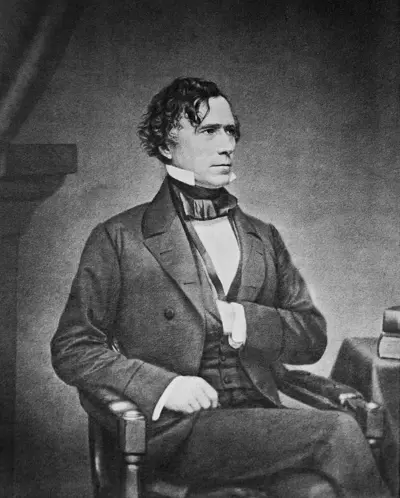
Franklin Pierce was the 14th president of the United States, serving from 1853 to 1857. A northern Democrat who believed that the abolitionist movement was a fundamental threat to the unity of the nation, he alienated anti-slavery groups by supporting and signing the Kansas–Nebraska Act and enforcing the Fugitive Slave Act, yet these efforts failed to stem conflict between North and South. The South eventually seceded and the American Civil War began in 1861.
