Richard Nixon Quotes
The American people are entitled to see the president and to hear his views directly, and not to see him only through the press
Richard M. Nixon, 1913-1994, 37th President of the United States (Republican, CA), Quoted in The Better Hearing Institute, Discover a World of Better Hearing
Sourced by: Eigen's Political and Historical Quotations


And the New York press is probably the most difficult and cynical in the world.

The only soldier ever so honored. At the beginning of WWII, President Roosevelt and Churchill wanted the U. S. Army to invade German and Italian North Africa. Marshall, General Eisenhower, and all the other military men, advised that while it was possible, it would be a diversion from the strategic objective of invading Europe. None the less FDR ordered the invasion. The effect on the American people was wonderful, It showed that the Germans were not invincible, increased enlistment and morale at home, and developed more popular support for the war. Later, Marshall learned much about Democratic leadership and he, himself became a very effective government leader, and began to appreciate FDR’s approach but with a little cynicism about democracy.


Truman had no rich supporters and the radio networks, like most businesses, supported his Republican opponent, Thomas E. Dewey. They charged high rates for a campaign speech. Truman could not afford to pay for the radio speech which convinced most that he could not possibly win.

See Dee Dee Myers’ Response {618820}


Trump, in contrast, to other president, in times of crisis, tendned to send tweets on the subject--often very political and divisive--instead of takeing the kind of leadership steps taht were taken by the otehr presidents of the 20th adn 21st century.

He was responding to criticism that the media was bashing the President.

The poem was in a dialect. “Gret” was “great” and “pint” was “point”.


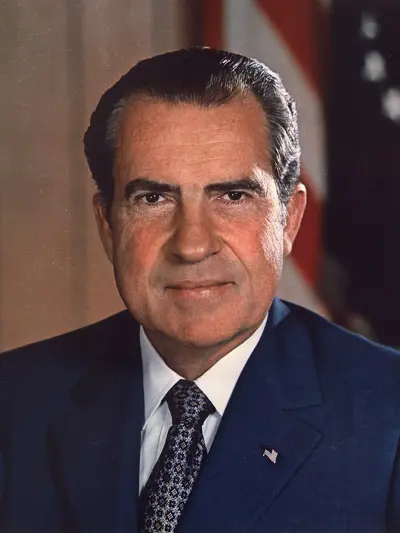
Richard Milhous Nixon was the 37th president of the United States, serving from 1969 to 1974. A member of the Republican Party, Nixon previously served as the 36th vice president from 1953 to 1961, having risen to national prominence as a representative and senator from California. After five years in the White House that saw the conclusion to the U.S. involvement in the Vietnam War, détente with the Soviet Union and China, and the establishment of the Environmental Protection Agency, he became the only president to resign from the office, following the Watergate scandal.
