John Adams Quotes
The [American] continent is a kind of whispering gallery and acts and speeches are reverberated from New York in all directions.
The capital was then New York. Not unlike today word spread quickly, far and wide, of events and speeches of the politicians. Adams complained that he was being quoted out of context and accused of changing his ideology and becoming a monarchist. His desire for a strong executive together with his proposals to give the executive formal titles of respect, led many to that conclusion. He was opposed to any hereditary monarchy and thus thought the criticism unfair. He was turned out of office after one term. Jefferson replaced him.
John Adams, 1735-1826, 2nd President of the United States (Federalist, MA), Letter to Benjamin Rush
Sourced by: Eigen's Political and Historical Quotations


3rd Earl Russell of Kingston. He was right on the 1st, and time will tell about the 2nd. But at the time he made this prediction, America was not a superpower, and was considered behind, England and France and just passing Argentina. At the time, America was reeling from the 1929 stock market crash and the Great Depression. The development of the United State through the FDR era including WWII was amazing. And by 1948 America was not only number 1, but the only Superpower at the time.

This is an example of the 3 leading democratic powers refusing to recognize the will of the people in other nations in determining their leadership choice. King Constantine I was a demagogue who maintained popularity with the Greeks by constant roiling and urging conflict with Muslim Turkey—the traditional enemy of the Christian Greeks. It was particularly hypocritical in many eyes since President Woodrow Wilson had established the principle of self-determination. However, Constantine I was a disaster for the Greek people. This is one of the earliest situations where American foreign policy support was in conflict between good sense and self-determination. The dilemma has faced America frequently since then and was especially acute in the 2012 “Arab Spring” Egyptian election of the Muslim brotherhood which turned out to be a disaster for Egypt but at an earlier time had won a national election.

Referring to the poor international reputation that America developed in the early 21st Century as a result of the Iraq War.


The George W. Bush administration was a very ideological one as opposed to pragmatic. They would not tolerate public officials who would say anything that might undermine an administrative ideological position. In particular, they did not want government scientists releasing any data or information that was not totally consistent with their ideology and program. They introduced a new policy within the government whereby no one could talk to a reporter or make a public speech or deliver a professional paper without first getting approval of administration “public affairs” agents first. Government scientists and other officials had never before been censored like this. Important scientific studies were not made public where they might not support the administration ideological positions. See {614691}.


Warning Donald Trump and his administration of the consequences of the United States that withdrawing from many of the major world issues would result in other nations replacing the US as world leaders on these issues.

The Democrat campaign operators, led by Robert Woolley, for the first time in an American Presidential campaign, used all the new techniques of public relations and advertising that had been developed. Many observers like the New Republic editors saw this in a negative light for American democracy. They wanted the old method where people met the candidates and had discussions with candidates or heard from others who had. It was in retrospect an editorial of nostalgia, as the country was growing so much that voter “acquaintance” with Presidential candidates was becoming more and more difficult.

In 1963 the White House Chief of Staff, Walter Jenkins, was arrested for homosexual solicitation at the YMCA. Johnson fired Jenkins but was personally very supportive to an old friend and advisor. However, the story was the major media story of the time. Johnson was preparing a major speech and hoped to get the Jenkins story off the front page.

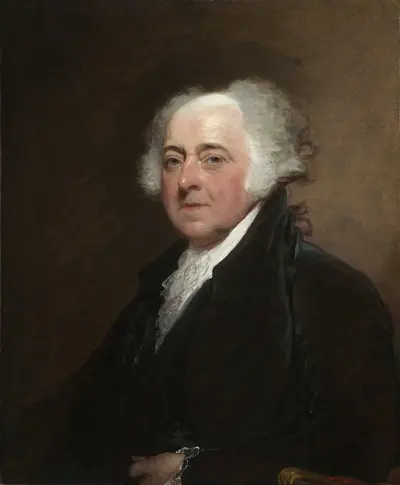
John Adams Jr. was an American statesman, attorney, diplomat, writer, and Founding Father who served as the second president of the United States from 1797 to 1801. Before his presidency, he was a leader of the American Revolution that achieved independence from Great Britain, and he served as the first vice president of the United States. Adams was a dedicated diarist and regularly corresponded with many important figures in early American history, including his wife and adviser Abigail Adams and Thomas Jefferson.
