James Connolly Quotes
The agricultural and industrial system of a free people, like their political system, ought to be an accurate reflex of the democratic principle by the people for the people, solely in the interests of the people.
Executed by the English for his part in the Easter Uprising.
James Connolly, 1868-1916, Founder, Irish Socialist Republican Party, Military Commander of Republican Forces in Dublin, Irish Socialist Republican Party, 1896
Sourced by: Eigen's Political and Historical Quotations


The Diggers were a religious-economic movement that even today would be considered very radical. They advocated the right of the poor to go onto public lands and farm them—thus the name “Diggers.” Beyond their opposition to the private ownership of land to the exclusion of the poor, Winstanley and the Diggers promulgated another very modern doctrine: That the poor should take the responsibility and have the right to determinine how the society should provide for the poor. A version of this became one of the Mottos of the Poverty Program of 1964. See {616966}.


Some people think that this quotation was partially copied from Lincoln’s Gettysburg Address. However, he gave this speech more than a decade earlier. Lincoln might have been familiar with it. His statue is in the U. S. Capitol.


The king had his first meeting with the new Prime Minister:
The Irish Catholic Church forbade the party to include this language and it was deleted from the adopted Constitution.

Socialism in its then pure form had the state owning and controlling all the major assets of the nation. In this sense it was contradictory to individual freedom and hence democracy. However, in the years after Tocqueville’s quotation and the industrial revolution, socialism has gradually moved away from state ownership and operations of all institutions and resources. Democracy has tended to adopt a more regulatory view to control the excesses of unbridled capitalism. The range of democratic nations by the 21st century encompassed differences but some were described as “social democracies” and had some state ownership but were basically capitalistic economies. Even the self-described Communist nations had become heavily capitalistic albeit with less political freedom. At the same time, even the United States—the epitome of 21st century capitalism, owned and controlled a few of the resources and means of production and tended to regulate the others—a substantial difference from the American democracy which Tocqueville studied.

formerly 2nd Viscount Stansgate


At the time, this was not popular with many socialists who had given up on the lack of fairness and equity of the capitalistic system. A century later, most politicians and political philosophers had given up on socialism ever meeting Bauer’s test, and Capitalism was well ensconced in Western Democracies.

The Income tax had been ruled Constitutional by the Supreme Court in 1881, but the then “new” Court—the one that would render the Plessy v. Furgeson decision—was a more conservative one. By a 5-4 partisan decision, the Supreme Court reversed itself and killed the income tax until a Constitutional amendment could be passed 19 years later in 1913.

This was a fascinating definition of socialism in that it was not an absolute definition. It was to the ediors simply and improvement over the status quo in certain areas. Also, unlike Communism, democracy is a required element of Socialism.

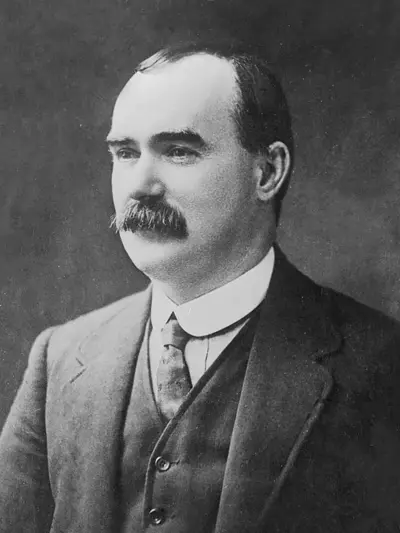
James Connolly was an Irish republican, socialist and trade union leader. Born in the Cowgate area of Edinburgh, Scotland, to Irish parents Connolly left school for working life at the age of 11, and became involved in socialist politics in the 1880s.
