Charles D'Avenant Quotes
The act for maintenance of the poor is the true bane and destruction to all the English manufactures in general. For it apparently encourages sloth and beggary; whereas if the legislative power would make some good provision, that workhouses might in every parish be erected, and the poor, such as are able, compelled to work, so many new hands might thereby be brought in, as would indeed make the English manufactures flourish.
Workhouses were factories using unskilled or semiskilled labor established by the government to employ poor people constructively. The problems caused by these were many. The government workhouses competed with private factories, and generally taught no skills so that a poor person could ever escape poverty. Opponents of big government complained that the government was adding millions more people to its employment roles. Conservatives have liked the idea of requiring work for welfare benefits wherever possible, but they do not care for the other problems. America instead has workfare where welfare recipients must work where possible but they work for private firms. This tends to break down when there are no or few priate jobs available as in a recession. The belief that welfare will erode the quality of the work force in general, has proved to be a false notion, but it was widely held in 17th century England and is still held by some people. The problem of work and welfare is a very complicated one.
Charles D'Avenant, 1656–1714, English Economist, An Essay on the East-India Trade, 1697
Sourced by: Eigen's Political and Historical Quotations


Welfare reform was desired by liberals as well as conservatives. They just had different ideas of how best to reform the system.


This quotation is significant in that it tells us the methods of coping with poverty—the early American form of a social safety net.


The Pool Laws provided economic and food relief for the very poor—an early type of welfare. Malthus and other conservatives hated the Poor Laws, but many like Malthus felt it immoral to terminate what was then the only social safety net. And none of the critics could suggest anything better and especially anything that would eliminate poverty altogether. The same issues were to be fought out in America during the Hoover Administration when the Great Depression struck. Hoover’s refusal for government to be the social safety net together with his inability to improve the economy, led to his ousting and the establishment of the New Deal with FDR.

This was quite unusual at the time when Kings were more interested in buying the loyalty and support of the rich and powerful nobles.


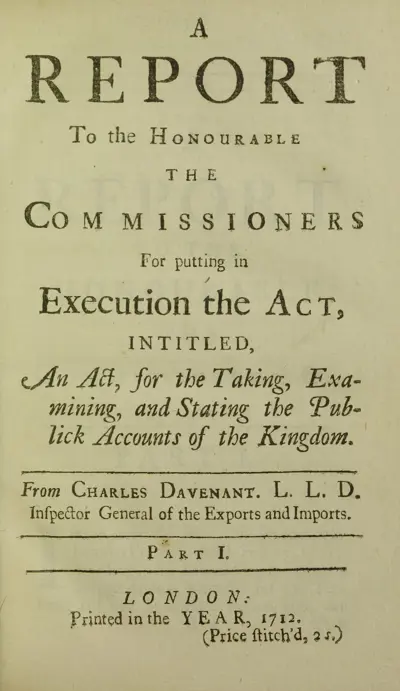
Charles Davenant (1656–1714) was an English mercantilist economist, politician, and pamphleteer. He was Tory member of Parliament for St Ives (Cornwall), and for Great Bedwyn.
