Al Gore Quotes
That's the President of the United States you're talking about, pinhead.
The Vice President was on David Letterman's show when the host told an undignified joke about President William Clinton.
Albert Gore Jr., U.S. Senator (Democrat, TN), Vice President of the United States (Democrat, TN), Nobel Peace Laureate, Quoted in USA Today, September 10-12, 1993
Sourced by: Eigen's Political and Historical Quotations

Moyers was also an ordained Baptist Minister. At a White House dinner, Moyers was asked to say grace. He did so in a soft and reverent voice. President Johnson, seated far away, and not hearing Moyers words clearly said in a loud voice, “Speak up, Bill. Speak up.” Moyer’s response followed.

Fischer was in the midst of a parliamentary debate and the President had ruled against him on a procedural matter.


Except of course for their “enemies.”

Samuel Langhorne Clemens, 1835-1910

Goodpaster served as Staff Secretary and Defense Liaison Officer to President Eisenhower from 1954–1961. McCarthy accused many competent, loyal Americans of disloyalty, incompetence and treason. The reason that this particular quotation was noteworthy was that it particularly offended President Eisenhower and galvanized him into action to stop McCarthy’s excesses. See {632334}.

The New York City comptroller was outraged by the new president of the Board of Alderman, former congressman Fiorello La Guardia, who later became mayor of New York. The two men clashed constantly, especially at meetings of the New York City Board of Estimate, where the comptroller made an unusual request of the chairman:


Dwight D. Eisenhower had become President of Columbia University. At one of his first meetings with the Faculty Senate, Eisenhower in response to a question stated that the University could not countenance such a policy. At this point, Professor Highit, the Dean of the Faculty Senate, interrupted Eisenhower with this legendary quotation. At Columbia as well as many other of the best private universities, it is the faculty Senate that is the highest educational policy making organ. See {634253} for one of the origins of this. Eisenhower and the University were both great but they were a bad fit. Some historians believe that it was the bad experience at Columbia that brought Eisenhower into Presidential politics. If he had been successful at Columbia, he might have stayed there for his career.


They never met. Harrison lost to Barkley by a single vote. Harrison’s fellow Senator from Mississippi was Theodore Bilbo, 1877-1947, a notorious racist and demagogue and Harrison would have nothing to do with Bilbo. However, in 1937 Harrison was a candidate for the Senate Majority Leader and appeared tied with Alben Barkley. Bilbo sent word to Harrison that if he would meet with him, Bilbo would vote for Harrison.


Morgan was always loyal to his war commander, George Washington, and resented the Jeffersonians bitterly because they criticized Washington’s policies Presidential policies.

Eisenhower was referring to MacArthur’s decision, as Army Chief of Staff, to take personal command of infantry, calvary and battle tanks he had ordered assembled to oust the WWI Veterans and their families from the shantytown they had erected in Washington DC to protest the fact that they had not been paid the bonuses that the law required. The attack on the protesting veterans was one of the great disgraces of American history. Eisenhower, knowing full well MacArthur’s penchant for strong attack, thought a more prudent officer should take charge of the delicate operation, and not the heavy-handed, aggressive General. See Quotation 643961.


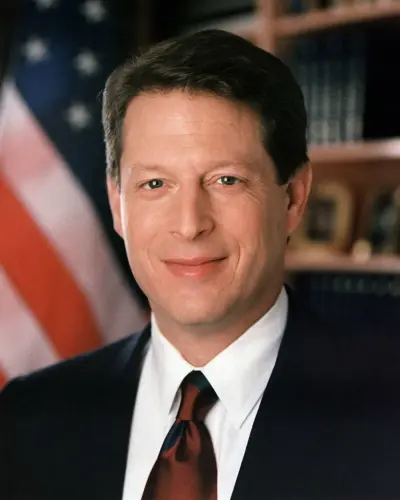
Albert Arnold Gore Jr. is an American politician and environmentalist who served as the 45th vice president of the United States from 1993 to 2001. Gore was Bill Clinton's running mate in their successful campaign in 1992 and the pair were re-elected in 1996. Near the end of Clinton's second term, Gore was selected as the Democratic nominee for the 2000 presidential election but lost the election in a very close race after a Florida recount. After his term as vice-president ended in 2001, Gore remained prominent as an author and environmental activist, whose work in climate change activism earned him (jointly with the IPCC) the Nobel Peace Prize in 2007. In 2008, Gore won the Dan David Prize for Social Responsibility.
