John Stuart Mill Quotes
So much barbarism, however, still remains in the transactions of most civilized nations, that almost all independent countries choose to assert their nationality by having, to their inconvenience and that of their neighbors, a peculiar currency of their own.
Mill, John Stuart. Principles of Political Economy. Vol. 2, John W. Parker, 1848, p. 147.


This was an old belief amongst the monarchs of Europe. The logic always involved comparisons with the landowners of the kingdom and the peasants or serfs compared with the merchants. The former two groups were tied to the land. The peasant could not afford to go anywhere else and if the landowner did, he lost his wealth. So both groups would support the king and fight off invaders. In contrast, the merchant to some degree had three things, each of which made him able to pick up and go to another land. They often had capital in the form of gold, silver or gemstones, that they could take with them to another country. Then they had inventory of whatever their trade was. This was more difficult to move than gold, but still much more movable than land. Last and most important, they had skills—they could read and write and knew arithmetic, skills which many rich nobles did not have. Even many of the kings were illiterate. Merchants could move to another land and use their skills there. So they were always suspect because they were not tied to the land as much as the others. Also. many merchants traveled abroad and had dealings with foreigners who were always considered potential enemies. So the merchants were all the more suspicious as they communicated with the “foreign enemy”. Immigrants were also suspect as they had family and friends in potentially enemy countries. If the immigrant was a merchant, he was doubly suspect. Jews were in many counties legally barred from owning land or practicing a profession, so many became merchants. Then they did not have the same degree of loyalty to the land and the rulers. This was one of the reasons for the anti-Semitism of the time.


In a House debate in 1923 on the Nordic or Latin discovery of America, Congressman Summers of Washington asked Italian-American Congressman La Guardia to yield to ask whether or not Christopher Columbus had come from "your country."


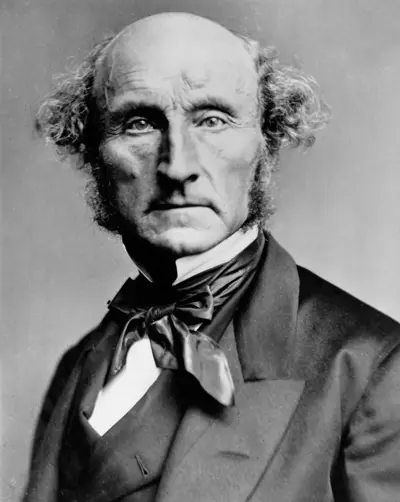
John Stuart Mill, usually cited as J. S. Mill, was an English philosopher, political economist, Member of Parliament, and civil servant. One of the most influential thinkers in the history of classical liberalism, he contributed widely to social theory, political theory, and political economy. Dubbed "the most influential English-speaking philosopher of the nineteenth century", he conceived of liberty as justifying the freedom of the individual in opposition to unlimited state and social control.
