Sun Tzu Quotes
So a military force has no constant formation, water has no constant shape: the ability to gain victory by changing and adapting according to the opponent is called genius.
Tzu, Sun. The Art of War. Translated by Thomas Cleary, Shambhala Publications, 1988, p. 113.


On military or foreign policy matters his view was that presidents ought not to rule anything in or out so that he/she can keep all the options open and not reduce future flexibility.


Not understanding this point has been the cause of much difficulty for military leaders from the war of 1812 through the Iraq war, the success or failure of the effort depended on a successful peace.


During the presidential debates George W. Bush stated that he would be very hesitant to use the military for nation building around the world. Less than a year later, the Bush administration, faced with the September 11, 2001 terrorist attacks, launched a massive attack on the Taliban regime in Afghanistan. After fighting and winning the war, the military soon realized that they would in fact be involved in nation building. However, with the assistance of the United Nations much of the humanitarian burden was lifted from the U.S. military.


Clark had commanded the American and NATO forces in the Serbian War where all the military and political objectives were accomplished with heavy losses to the Serbian’s and none to the allied side—what many think was the most successful war in American History. Like Eisenhower in WWII one great challenge was the political and strategic one of keeping the coalition of all the allied governments working together. His perspective had been like Eisenhower’s which was much wider and geopolitical than most military officers.
Clark was particularly brilliant in the Serbian War, where he led America and NATO to a major victory without a single American being killed. There had never been a major war like it, where air power and negotiating carried the victory. And yet, that strategy was not very useful for Iraq and Afghanistan Wars. See {597899} for another of his quotations in this theme.

The General refused. He had already achieved a strategic victory and it was only a matter of time when the Dutch would withdraw on their own as their supply lines were cut off and the populations wanted them out.

Grant’s overall strategy of attrition of the Southern troops and interdicting supplies and targeting Southern manufacturing and transportation was taking its toll and the Confederates tried a desperate gamble. Robert E. Lee’s tried to attack the Union in the North—Pennsylvania and Maryland threatening Washington and hoping to force the Union to sue for peace. But that left the Eastern part of the Southern heartland relatively undefended. Grant and Sherman, noting the opportunity, then sent Sherman to take Atlanta and destroy all the factories, railroads, and warehouses of food, arms and munitions, then march to the sea and back up the Atlantic Seaboard, freeing slaves and destroying anything and everything that could support an Army and putting enormous pressure on the Southern men fighting with Lee to return home and prevent starvation as there were now few slaves to work the farms. It was the stroke that, as intended, crippled the Confederacy’s ability to wage war. But Grant and Sherman both credited the Southern strategy with opening the opportunity—hence it was the Confederacy that “planned” Sherman’s March. The details of the plan were worked out by Sherman and his staff.
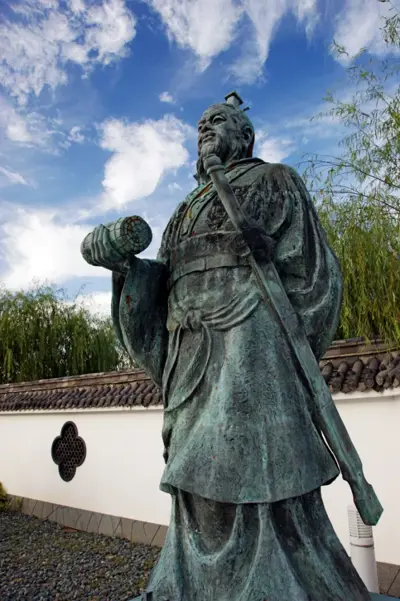
Sun Tzu was a Chinese general, military strategist, writer, and philosopher who lived in the Eastern Zhou period of ancient China. Sun Tzu is traditionally credited as the author of The Art of War, an influential work of military strategy that has affected both Western and East Asian philosophy and military thinking. His works focus much more on alternatives to battle, such as stratagem, delay, the use of spies and alternatives to war itself, the making and keeping of alliances, the uses of deceit, and a willingness to submit, at least temporarily, to more powerful foes. Sun Tzu is revered in Chinese and East Asian culture as a legendary historical and military figure. His birth name was Sun Wu and he was known outside of his family by his courtesy name Changqing. The name Sun Tzu by which he is best known in the Western World is an honorific which means "Master Sun".
