Pius XI Quotes
Since, therefore, the conjugal act is destined primarily by nature for the begetting of children, those who in exercising it deliberately frustrate its natural power and purpose, sin against nature, and commit a deed which is shameful and intrinsically vicious.
This is a very important quotation because it is the official ban of the Roman Catholic Church against birth control of all forms. Prior to 1930, there was no official prohibition against birth control although individual Roman Catholics had argued that it was sinful. For example, see St. Augustine {625106}.
Pius XI, 1857-1939, [Achille Ratti], Roman Catholic Pope, Papal Encyclical: Casti Connubii, December 31, 1930
Sourced by: Eigen's Political and Historical Quotations

This is one of the earliest Christian statements about the immorality of contraception. There was no official position of the Roman Catholic Church against contraception, until 1930 when Pope Pius XI issued his stricture. See {625105}. The reference to Onan is to the Old Testament. Onan however was not using contraception. He was masturbating. Augustine’s view was that everything sexual was designed by God for procreation. Therefore, any sexual function, not for the purpose of procreation, is inappropriate. Contraceptive techniques were used in Biblical times as well as later. The only difference was the technological sophistication and reliability of the different devices and methods.

This quotation is often used by those who support the right to abortion to argue that the moral argument against abortion is exactly the same against contraception. And that if the state can interfere with the right to an abortion, then the state can equally interfere with the fight to family planning by means of contraception, and indeed such was the law until 1963. It is true that before that and since the Roman Catholic Church has argued that both abortion and contraception should be unlawful. Abortion opponents attempt to separate the two as only a small majority of Americans favor the right to an abortion while an overwhelmingly large proportion support the right to use contraception. Abortion opponents, generally avoid the contraceptive issue and try to isolate the abortion question.


Craig’s bias against Catholics was so great that it never occurred to him that he was addressing a Catholic Prime Minister.
Condoms and other birth control usage had been forbidden by the Catholic Church. However, most American Catholics utilized artificial birth control devices anyway. However, the official church positions inhibited and influenced politicians throughout the nations. Even as late as 1963 selling birth control devices was illegal in parts of America. A pharmacist was sentenced to jail for filling a prescription for a condom for a couple where the woman could not bear a child safely as the result of a physical condition. The Supreme Court reversed the conviction.
The Prime Minister’s wife, a Roman Catholic, like most Roman Catholics in Europe and America practice contraception despite the fact that the Catholic Church still maintains that artificial means of birth control is a sin. Rarely are such personal matters discussed with the media in Great Britain which respects the personal privacy of public figures more so than the United States. However, Mrs. Blair and her husband have been particularly open throughout their public career.
In 1877 Annie Besant and Charles Bradlaugh attempted to publish The Fruits of Philosophy in Britain. It was a book on Birth Control. The two were immediately arrested and charged with publishing an ‘obscene’ book. Gifford was the Public Prosecutor. The authors were convicted and sentenced to 6 months in prison. However, they appealed and were exonerated in the appeal. The case was good for Gifford who went on to become Lord Chancellor of Britain. The trial was a strong motivator for Annie Besant to have a very activist career thereafter.


The power of the Catholic hierarchy on the politicians had waned and the laws against contraception and divorce were being relaxed to the chagrin of the Archbishop who described the change as a curse upon the country. However, Ireland then was the only industrial democracy in the world where contraceptives were illegal and divorce impossible. Three years later contraceptives were made legal by prescription and a train full made the journey from Belfast in more modern Northern Ireland to the South. See {639627}.


This is a very valuable historical quotation as it gives is a flavor of 19th century attitudes about birth control. Malthus was one of the first to warn about the danger of overpopulation. But even he repudiated birth control as a potential solution. Toynbee was giving a scholarly academic lecture and academics whenever they discussed birth control were expected by many to speak or write only in Latin—the “dead language.” Toynbee, a very young brilliant man—he died at only 31—was considered very daring as he actually discussed it in English. The assumption of all at the time, in that Protestant culture, was that birth control was immoral. The logic of it was that sex was pleasurable, but as children would likely result, the parents would have and accept responsibility. Pleasure without the concomitant responsibility might lead to sex for pure enjoyment and much time spent with pleasure. The production of children and the responsibility thereof was therefore a break and limitation on the amount of time that people would spend with sex. There was the Protestant work ethic and too much sex would detract from work, prayer, parenting, scholarship, and activities of social responsibility. In America there was a similar cultural view of birth control and even as late as 1963 the criminal law was used to restrict birth control. A Connecticut pharmacist was jailed for filling a doctors prescription for condoms for a married couple where the wife’s life was threatened if she bore another child. The Supreme Court overturned the conviction, but birth control and abortion were conflated. Even today, many of the so called “pro life” organizations not only oppose legal abortion, but they want the government to restrict birth control, though tactically they emphasize the abortion publicly. The English and American family planning advocates like Margaret Sanger were up against these attitudes on which there is stll some controversy into the 21st century.


Jorge Mario Bergoglio. This quotation was reprinted in religious and secular organs of almost all religions as the message was universal and could apply also to non-Roman Catholic Churches and non-Christian religions. The Pope in this statement did not change church doctrine one bit. It urged a major change in tactics, context, emphasis and style. Extreme fundamentalists within the Roman Catholic church and without, however, saw the statement as a softening of the moral position of the church regarding these controversial areas. Most however welcomed his quotation as long overdue and a stylistic throwback to a different time where people were less educated and less informed by media.
In America (and Europe) while the Roman Catholic Clergy oppose contraception but the majority of Catholics did not agree and used artificial contraception. There is a small proportion of the Evangelical churches who oppose contraception, but at this time over 90 percent of Evangelical clergy did not.
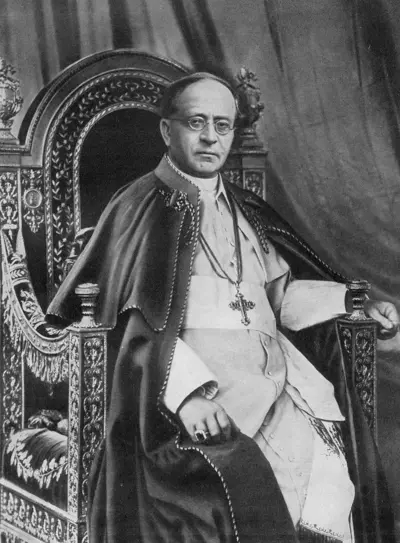
- Born: May 31, 1857
- Died: February 10, 1939
- Nationality:
- Profession:
Pope Pius XI (Italian: Pio XI), born Ambrogio Damiano Achille Ratti, was head of the Catholic Church from 6 February 1922 to his death in 1939. He was the first sovereign of Vatican City from its creation as an independent state on 11 February 1929. He took as his papal motto "Pax Christi in Regno Christi," translated "The Peace of Christ in the Kingdom of Christ."
