Pope Paul VI Quotes
… any action which, either in anticipation of the conjugal act, or in its accomplishment, or in the development of its natural consequences, proposes, whether as an end or as a means, to render procreation impossible
Paul VI, 1897-1978, Giovanni Battista Montini, Catholic Pope, Definition of Birth Control which is viewed as sinful, Encyclical letter Humanae Vitae 14, 1968
Sourced by: Eigen's Political and Historical Quotations


There were few reformers who had such a long, extensive, and activist career in both England and India. She began her career as a minister’s wife but was literally turned out of her house by her husband for whom she was not religiously orthodox enough. This started her religious activism which ended with her as an atheist. She led a match-girl’s strike, founded a Hindu college in India, and was even arrested for pornography in England when she wrote a book advocating birth control. She is on many lists of “Great Indians” along with Gandhi and Nehru. She was Jiddu Krishnamurti’s teacher.

In 1877 Annie Besant and Charles Bradlaugh attempted to publish The Fruits of Philosophy in Britain. It was a book on Birth Control. The two were immediately arrested and charged with publishing an ‘obscene’ book. Gifford was the Public Prosecutor. The authors were convicted and sentenced to 6 months in prison. However, they appealed and were exonerated in the appeal. The case was good for Gifford who went on to become Lord Chancellor of Britain. The trial was a strong motivator for Annie Besant to have a very activist career thereafter.

This quotation is often used by those who support the right to abortion to argue that the moral argument against abortion is exactly the same against contraception. And that if the state can interfere with the right to an abortion, then the state can equally interfere with the fight to family planning by means of contraception, and indeed such was the law until 1963. It is true that before that and since the Roman Catholic Church has argued that both abortion and contraception should be unlawful. Abortion opponents attempt to separate the two as only a small majority of Americans favor the right to an abortion while an overwhelmingly large proportion support the right to use contraception. Abortion opponents, generally avoid the contraceptive issue and try to isolate the abortion question.

The power of the Catholic hierarchy on the politicians had waned and the laws against contraception and divorce were being relaxed to the chagrin of the Archbishop who described the change as a curse upon the country. However, Ireland then was the only industrial democracy in the world where contraceptives were illegal and divorce impossible. Three years later contraceptives were made legal by prescription and a train full made the journey from Belfast in more modern Northern Ireland to the South. See {639627}.


Not all abortion opponents object to birth control, but many do believing the two practices to be morally sinful. While the abortion conflict is given more publicity there are many in America who would return to the pre 1963 era when birth control was criminalized.


Actually it was as late as 1963, that the Supreme Court ruled that States could not make the sale of birth control devices or drugs illegal. In many jurisdictions in the United States, women who do not have insurance and cannot afford birth control, there are state and private organizations, like Planned Parenthood, who will provide them. However, some conservative forces are trying to put Planned Parenthood out of business. A few doctors and nurses who perform abortions and proscribe birth control have been murdered by the fanatics. Almost of the so called “pro life” forces not only oppose abortion but contraception and family planning as well. They tactically tend to concentrate first on abortion, but most also believe that the life and death issues are for them the same, as opposed to most American feelings. The literal prohibiting Biblical injunctions are even more specific about birth control than abortion.
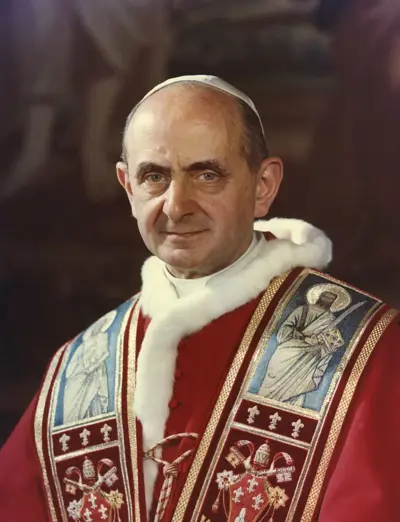
Pope Paul VI was head of the Catholic Church and sovereign of the Vatican City State from 21 June 1963 to his death in 1978. Succeeding John XXIII, he continued the Second Vatican Council, which he closed in 1965, implementing its numerous reforms, and fostered improved ecumenical relations with Eastern Orthodox and Protestant churches, which resulted in many historic meetings and agreements.
