Alexander the Great Quotes
Shall we neglectfully pass thee by, now thou art prostrate on the ground because thou once invaded Greece, or shall we erect thee again in consideration of the greatness of thy mind and thy other virtues?
He decided to let the statue lie and not revive the image of Xerxes and instead simply proceed with the administration and governance of what was then occupied Persia. He maintained most of the Persian laws and customs including much that came from Xerxes but did not elevate the personality of the great king. However, it was not Alexander’s technique to govern by cults of personalities he and his associates erected few symbols of their own aggrandizement until after Alexander’s death when some of his associates adopted the more traditional approach to things.
Alexander III ["The Great"], 356-323 BC, King of Macedonia, Statement to a large fallen statue of the Persian King Xerxes as Alexander’s army conquered the large Persian palace of their arch enemy
Sourced by: Eigen's Political and Historical Quotations


See Wakil Ahmad Muttawakil {608419} and Jamal’s other quotation {604664}

The Persians arrived at an abandoned city and burned some of the major buildings. All the Athenian men went to the island of Salamis where he gathered Greeks from the other city states. They boarded ships and tricked the march larger Persian fleet into coming into the narrow part of the straits where it could not maneuver. The Greeks destroyed the Persian fleet with relatively few losses and with it went Xerxes dreams of conquest of the Greeks. The Persian navy could not feed their army and the Persians, the greatest empire of the day, retuned to Persia in defeat.

Ironically, when he attacked Athens in 480 BC, the Athenians under Themistocles, abandoned the city—see {612656}—and lured the overly-confident Xerxes into a sea battle at Salamis where the Persians were totally destroyed. A few public buildings of Athens were burned, but before Xerxes could fulfill his vow, he was defeated and had to retreat to Persia.

Alexander and his army were approaching the city of Persian King Darius. The King asked for a truce assuming that a settlement of treasure and land could be worked out as war was usually fought in those days. However, Alexander had led a punitive war where revenge was the major objective. Alexander rejected a truce and chased Darius to his death.


What is particularly interesting about this quotation is that the author was not a religious leader or a philosopher, but a hard-nosed military man and ruler. He recognized the corrosive effect on a society that a thirst for revenge can bring.
His army had been so successful that many of his men had all the riches they ever dreamed of and great glory as well. Some just wanted to slow down and enjoy the conquered lands where they had been received very cordially as Alexander’s “occupation” was much more benign than the Asian rulers had been. Most however wanted to go back to Macedonia and enjoy their wealth and prestige. This statement of Alexander’s turned most of the men around.


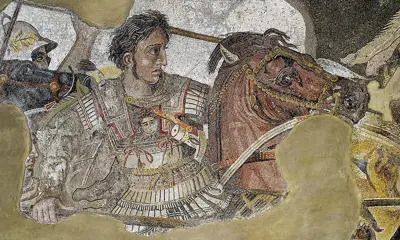
Alexander III of Macedon, commonly known as Alexander the Great, was a king (basileus) of the ancient Greek kingdom of Macedon and a member of the Argead dynasty. He was born in Pella in 356 BC and succeeded his father Philip II to the throne at the age of 20. He spent most of his ruling years on an unprecedented military campaign through Western Asia and Northeastern Africa, and by the age of thirty, he had created one of the largest empires in history, stretching from Greece to northwestern India. He was undefeated in battle and is widely considered one of history's most successful military commanders.
