Dwight D. Eisenhower Quotes
Reduction in taxes will be justified only as we can show we can succeed in bringing the budget under control.... Until we can determine the extent to which expenditures can be reduced, it would not be wise to reduce our revenues.
Dwight D. Eisenhower, 1890-1969, 34th President of the United States (Republican, KS), Supreme Allied Commander in Europe, Annual Message to Congress, February 1953
Sourced by: Eigen's Political and Historical Quotations


Attacking opponent Ronald Reagan's campaign promises:. Anderson lost the election. Reagan made good on the last two of the three promises, but ran up the largest deficits in American history.


Although Reagan vetoed some spending that he disapproved of, he wanted so much spending on his favorite programs that he not only never brought the budget under control but his spending created the largest deficit in American history -- until George W. Bush squandered the Clinton surplus and exceeded Regan’s spending greatly and left President Obama with the greatest budget deficit in world history and a collapsing economy. Ironically, despite the fact that Reagan ran up huge deficits for the time, he always verbally advocated balanced budgets and many people in the country were persuaded by Reagan of the importance of balanced budgets. It was President Clinton who balanced the budget and eliminated the Reagan deficits.

Bloomberg was one of the few people who say the meltdown of 2008 coming. His principle of saving a surplus for spending in the downturns, which served New York so well goes against most Democrat and Republican politicians. If there is a surplus, the Democrats want to spend it. The Republicans want to cut taxes and return the surplus. Neither is prepared for an economic slowdown.


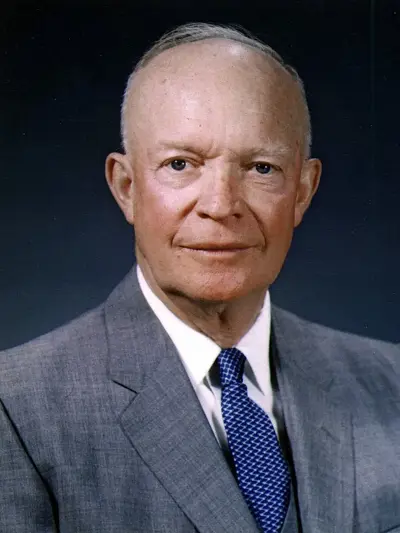
Dwight David "Ike" Eisenhower GCB OM GCS CCLH KC NPk was an American military officer and statesman who served as the 34th president of the United States from 1953 to 1961. During World War II, he became a five-star general in the Army and served as Supreme Commander of the Allied Expeditionary Force in Europe. He was responsible for planning and supervising the invasion of North Africa in Operation Torch in 1942–43 and the successful invasion of Normandy in 1944–45 from the Western Front.
