New York World Quotes
[President Theodore Roosevelt] has proven himself to be wiser and more resolute than leaders of his party in Congress, who sit supinely in the path of a rising storm of popular indignation and refuse to do anything to ‘disturb the business of protecting monopolies by law.
New York World, Editorial, April 26, 1902
Sourced by: Eigen's Political and Historical Quotations

Actually, both political parties had a range of opinion on the issue of control of the trusts, monopolies and large corporations. Roosevelt and his liberal wing of the Republic opinion were for regulating corporations and strengthening and enforcing the anti-trust laws. However, many of his party refused to admit that there were any abuses and/or if there were, the effect of Federal regulation and anti-trust enforcement would be worse that then problems caused by the trusts. At the same time, the Democrats had Bryan’s wing that wanted to break up the trusts and large corporations, and that is why Roosevelt had so much public support—enough to pass the legislation and make the President’s initiatives very popular. Roosevelt a shrewd campaigner attacked the Democrats knowing full well that many agreed with him, and ignored the conservative wing of his own party who were the ones who actively opposed his corporate reform effort.


During The Depression although business in general was doing very poorly, there were a few which had grown immensely powerful and abused the power as there was little or no regulation at the time.


See {642189} where Sherman explained some of the reasons for the law.

This is a very important historical quotation because it clearly stated the left wing view of regulation. Large Business had been so unethical and illegal at the time that the majority of Americans and Congress, together with a Republican President, thought that it would be good to “weld” the growth and development of large companies to the Government. The right wing saw this as extreme Communism. Over time, when corporate greed and excesses had been controlled by government and was not as prevalent, the inhibition on growth and development of welding corporations to Government was recognized and a period of deregulation followed with most Americans not wanting to allow large companies to be completely deregulated and also not wanting them welded to the government. The extent of regulation has been the political contest with the extreme left and extreme right still holding to their ideological positions and sometimes paralyzing the middle as in the Obama administration.


Boeing had the foresight to invest in the concept of Air Mail by bidding low at the beginning, becoming the best in the nation, and then raising prices when no one else can compete—a technique called “buying in”. However, he was so successful that he soon had a monopoly on all the airmail in the country. Each new airmail contract would require more and more capability and Boeing used the existing contracts to finance the R&D and training of manpower to present a better and better service. Soon, no other company could compete at any price. Boeing indeed had a monopoly but each step of the building of it he did at the request of the government or was the low bidder and saved the taxpayer money. The airmail contracts were canceled and air service was nationalized. William Boeing was so disgusted by the way he was treated in the Congressional Hearings, that he sold his interest in the Boeing Company and would have nothing to do with making planes or providing services to the government thereafter.


TR came from a wealthy, upper class family, and because of his position favoring regulation of corporations he was called a traitor to his class by many.

Samuel Langhorne Clemens, 1835-1910. The nature of telephone technology made it easy for companies to obtain monopolies for different areas of the country. When there is a monopoly, there is a huge tendency for the controlling company to charge very high prices and have poor customer service as the usual competition required for quality performance under capitalism is nonexistant. So in 1890, there was the same resentment of the telephone companies, that existed over a century later when there was still a monopoly. Regulation helped somewhat, but the capabilities of the monopolist began to include lobbying and campaign contributions so that typically, in the 21st century, the local telephone companies had much control over the State Commissions that were supposed to regulate them. Long distance service, whose monopoly was broken up by the Federal Courts became a wonderful service for customers and the prices were a tiny fraction of what they had been under their old monopoly.


Federal regulation of corporations involved in Interstate Commerce was then a “radical new notion”.
The President and his new appointee were half joking but many of the large corporations were attacking the new department and its head frequently. The extreme conservatives used the technique of personally discrediting the head of the agency to discredit the agency and its activities. The President himself was so popular that they did not dare attack him.

Note the difference in standards that existed at the beginning of the 20th century. The Wall Street Journal was offended because corporations had paid agents in labor unions, legislatures and political parties. A century later it was common for corporations to have many lobbyists (overt and covert) in legislatures,. They had key representatives in political parties and gave the parties huge fiscal and service contributions and not only had their paid agents in labor unions but often sometimes paid the officers of the unions. The morality of 1904 seems almost quaint.
Innovative science and technology from Edison and Tessla had produced an electrical industry that rapidly formed into a monopoly.


See {641989} & {641989} for more on the Radio Channel corrupt giveaway.

The historian was comparing Obama to other historical presidents who either had a majority of both Houses of Congress or had an opposition party that was generally quite cooperative and willing to compromise for the sake of running the country smoothly. At this point in time there was a Tea Party wing of the Republican that was particularly negative and obstructionist. They tended to threaten and intimidate the main stream Republicans who used the filibuster to block legislation the majority of Senators had voted for more times than all the other Congresses in American history. And that was only in Obamas first 6 years.

She was then the European Commissioner for Competition.


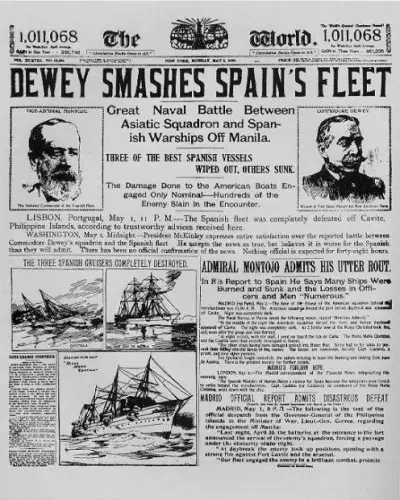
The New York World was a newspaper published in New York City from 1860 until 1931. The paper played a major role in the history of American newspapers. It was a leading national voice of the Democratic Party. From 1883 to 1911 under publisher Joseph Pulitzer, it was a pioneer in yellow journalism, capturing readers' attention with sensation, sports, sex and scandal and pushing its daily circulation to the one-million mark. It was sold in 1930 and merged into the New York World-Telegram.
