Robert Kennedy Quotes
President Kennedy has named two Negroes to District Judgeships and appointed Thurgood Marshall to the United States Court of Appeals. When I came to the Department of Justice, there were only ten Negroes employed as lawyers; not a single Negro served as a United States Attorney - or ever had in the history of the country. That has been changed.
Kennedy, Robert F. The Pursuit of Justice. Harper & Row, 1964.


The Nixon "Southern Strategy" was that if the Republican Party made extensive efforts to appeal to minorities, given the previous decades of support of white supremacy, they would only be successful with a few, whereas if the Party went in the other direction and supported the Whites fighting against the Democratic initiated, racist hated, Civil Rights Act, they would get almost all the racist Southern Democrats, which were most white males and many white females. This racist policy enabled the Republicans to gain control of the Federal Government more often than not whereas before, it was very unusual.


Grady, representing what he called the New South pole kindly of Blacks in the North (See Quotation 643652), but gave his highly racist views to his Southern brethren—see Quotation 643649. He overtly in the North advocated liberty and the right to vote for Blacks (more than most Southerners at the time, but wanted the Federal role limited so that the enforcement of Black liberty and the voting franchise to be left to the States. And that is what occurred for the next half century. However, the state governments not only did not provide liberty and the voting franchise, the Southern States passed legislation and opted policies allowing KKK and other terror and intimidation so that Blacks would not exercise their rights to vote and be free. It is had to tell whether he was naive enough to believe that the Souther States would do what he claimed in the North or whether he not only realized what was likely to happen with the states in charge, but presented a moderate picture deliberately to keep the Federal government from interfering with the prerogative of the states to discriminate against Blacks. His racist views in his Southern speeches (for example, see quotation 643649) lead many to believe the latter view.


At the time, the Southern segregationists were all Democrats and they blocked any Democratic attempt to pass any Civil Rights legislation. When he could not get a Civil Rights commitment from his own party, Powell turned to the Republicans and the President wrote this letter. In return, in November, Powell endorsed and supported Eisenhower instead of Stevenson, his own party’s nominee. Eisenhower could not get any legislation on Civil Rights as the Southern Democrats would always block it. When President Lyndon Johnson finally forced the 1963 Civil Rights Act through the Congress, the racist Southern Democrats cut a deal with Goldwater and the conservative Republicans, and switched parties. Since then the Civil Rights stance of the two parties reversed. The Democrats were thereafter pro Civil Rights and the Republicans, the party of Lincoln and Reconstruction, thereafter reversed their Civil Rights position and opposed progress in this area.

This statement in the President’s Second Inaugural. Infuriated the politicians of the Southern States. Remember, at the time there was brutal discrimination throughout most of the South, and more important to the South than the fact if the discrimination was their perverse view that this was a right, proper and necessary state of affairs for the welfare of the people and was required by Christianity’s mandates as they read the Scripture. For the President to state so publicly that discrimination was contrary to the law, justice, good faith, citizenship and fairness was a major shock. Since the early days of reconstruction after the Civil war in the Grant Administration, no president had spoken so publicly and openly against the Southern status quo.

The great contralto singer, Marian Anderson, an African American, had been refused by the Daughters of the American Revolution the use of Constitution Hall as a venue for her concert based on their White Performers Only policy. First Lady, Eleanor Roosevelt, resigned in protest from the DAR and she and the President asked Secretary Ickes to arrange a public concert at the Lincoln Memorial and he did. There was no Civil Rights Act at the time.


Johnson had proposed an extremely strong civil rights bill. Most Washington insiders assumed that he would gain favor amongst fair minded whites and Blacks for making the attempt, but then he would compromise with the Southerners, and water down the bill to something that had little or no teeth. His staff were trying to learn from Johnson, which aspects of the bill he was willing to compromise on assuming that the President could never get Congress to pass the bill in its original form. They were really surprised at the President’s answer and assumed that he could not do it. They were more surprised when he did drive the bill through Congress without any substantive compromises. It was the most powerful and effective Civil Rights legislation passed since Reconstruction a century earlier.


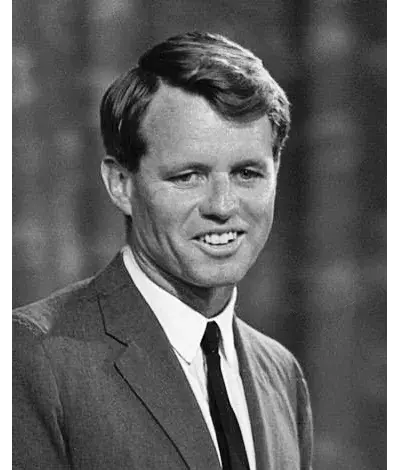
Robert Francis Kennedy, also referred to by his initials RFK or by the nickname Bobby, was an American politician and lawyer who served as the 64th United States Attorney General from January 1961 to September 1964, and as a U.S. Senator from New York from January 1965 until his assassination in June 1968. He was, like his brothers John and Edward, a prominent member of the Democratic Party and has come to be viewed by some historians as an icon of modern American liberalism.
