Al Gore Quotes
Prebuttal
The first printed appearance of the world occurred in a Washington Post article by Dan Batlz, May 26, 1996.
The news coverage cycle of a Presidential campaign had become so accelerated that candidates commonly gave copies of major addresses of press before the address was delivered so that the spinners could get to work and frame the issues of the speech so that it will be reported in a way favorable to them. The Clinton-Gore campaign first came up with a weapon to neutralize this pre-release of speeches. Specifically, they read copies of the speech and instead of waiting until the speech was given to rebut it, they issued the rebuttal before the speech was given so that their spinners could have an equal shot at influencing the reporting of the speech when it would be given. Gore coined the word, ‘prebuttal’ to describe the new technique. Soon everyone was issuing prebuttals to addresses whenever they were released in advanced—and prebuttals began to be issued outside of the campaigns and applied to any speech that any officeholder would give. The common sequence was: Address Release & Spin, Prebuttal & Spin, Speech Delivery, Rebuttal, Spin by both sides.
Albert Gore Jr., U.S. Senator (Democrat, TN), Vice President of the United States (Democrat, TN, Word Coined during the 1996 Presidential Campaign
Sourced by: Eigen's Political and Historical Quotations


See {584897} for a quotation from the speech. Spinning and giving advance copies of speeches to the press is not the invention of the 20th century media-savvy political handlers. It was a standard practice even in the 19th century.


Ryan told the national audience that President Obama had come to a factory in his district that as rumored to be closed. Obama had told the workers that the Federal government could assist and keep the factory open for many years. Then as Ryan explained, the factory closed the following year. He gave this as an example of Obama not keeping his word. However what Ryan did not say was that Obama had made the speech at the factory when he was a candidate for the Presidency, and then the factory was closed while George W. Bush was President and by the time he took office, the closure was done and the factory machines gone. And when Obama took office, our national economy was within days of complete bank and finance collapse. Obama saved most of the banks and then the American automobile industry. To suggest that Obama could have or should have done something for the factory that closed was shockingly misleading. It would have been a minor issue if some party hack had lied and made the same accusation. But this was the Vice Presidential Candidate whose acceptance speech was assumedly vetted by the Presidential Candidate’s staff. That is why the quotation was so memorable.

Referring to Donald Trump, the then Republican Presidential nominee whose background was in business and he was a strong promoter and had exaggerated and used hyperbole constantly in his adult life.


Ingersoll was considered to be the greatest orator and political thinker of his day, but his overt atheistic views curtailed his own elected political career. While Blaine did not win the nomination, this quotation is generally considered to be the greatest nominating statement in American political history. Blaine was dogged by his early career, close relationship with the corrupt railroad industry.


No Presient, before and perhaps since. was so effective with the press and the media. Yet Roosevelt did not use a basic technique of modern political presidential press techniques—that of always being “on message” and repeating the same point over and over. TR thought that would lead to loss of credibility and perhaps he was right because no one trusts what a modern President says today to the degree that TR was believed by both the press and the public.


TR was the first American President to speak in front of the sound motion picture cameras. He was so conscious of this new technology that the timed his speeches and marked major pauses to allow for the cameramen to change rolls of film.

Referring to the 1988 acceptance speech of Democratic Presidential nominee, Michael Dukakis:


Campaign speechmaking sometime posed additional challenges:


Referring to the candidate’s staff.


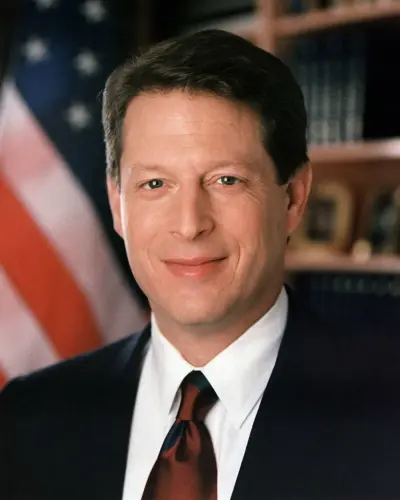
Albert Arnold Gore Jr. is an American politician and environmentalist who served as the 45th vice president of the United States from 1993 to 2001. Gore was Bill Clinton's running mate in their successful campaign in 1992 and the pair were re-elected in 1996. Near the end of Clinton's second term, Gore was selected as the Democratic nominee for the 2000 presidential election but lost the election in a very close race after a Florida recount. After his term as vice-president ended in 2001, Gore remained prominent as an author and environmental activist, whose work in climate change activism earned him (jointly with the IPCC) the Nobel Peace Prize in 2007. In 2008, Gore won the Dan David Prize for Social Responsibility.
