Gilbert K. Chesterton Quotes
Precisely because our political speeches are meant to be reported, they are not worth reporting. Precisely because they are carefully designed to be read, nobody reads them.
Gilbert K. Chesterton, 1874-1936, English Writer, "On the Cryptic and the Elliptic," All Things Considered
Sourced by: Eigen's Political and Historical Quotations


Ailes was the inventor of the "Video News Release", a deceptive practice which was so successful that politicians of all political stripes started using it. Then government agencies started promoting their programs using it. But soon private corporations adopted Ailes technique and made the Video News Release a mainstream advertising and public relations technique and by 1990, it had lost all ethical taints and was used throughout the world with very little of the old moral and ethical compunctions or stigma.


TR was the first American President to speak in front of the sound motion picture cameras. He was so conscious of this new technology that the timed his speeches and marked major pauses to allow for the cameramen to change rolls of film.


Romney and his surrogates had more than usual difficulty with getting their facts right. Fact checking organizations would call them on this and in April of 2012, Romney ran a TV ad that was grossly wrong and misleading. When asked about the expose of the falsehood of the ad, Newhouse made this classic response. The reason this is an important quotation is that the statement drew much more critical attention than the false had or its classification as untrue did. Even President Obama made fun of it in his campaign speeches. See Martin Amis {631017} for a serious critique of the meaning of the quotation.

Ryan told the national audience that President Obama had come to a factory in his district that as rumored to be closed. Obama had told the workers that the Federal government could assist and keep the factory open for many years. Then as Ryan explained, the factory closed the following year. He gave this as an example of Obama not keeping his word. However what Ryan did not say was that Obama had made the speech at the factory when he was a candidate for the Presidency, and then the factory was closed while George W. Bush was President and by the time he took office, the closure was done and the factory machines gone. And when Obama took office, our national economy was within days of complete bank and finance collapse. Obama saved most of the banks and then the American automobile industry. To suggest that Obama could have or should have done something for the factory that closed was shockingly misleading. It would have been a minor issue if some party hack had lied and made the same accusation. But this was the Vice Presidential Candidate whose acceptance speech was assumedly vetted by the Presidential Candidate’s staff. That is why the quotation was so memorable.

One of the reason’s that TR was so popular was that he was a very candid, clear and dynamic speaker who always said what he meant and meant what he said.


“Cant” is another word for oratory or speech, but has a manipulative shade to it.

The queen was a lot more sophisticated about the newspapers than politicians in the 21st century.


The Democrat campaign operators, led by Robert Woolley, for the first time in an American Presidential campaign, used all the new techniques of public relations and advertising that had been developed. Many observers like the New Republic editors saw this in a negative light for American democracy. They wanted the old method where people met the candidates and had discussions with candidates or heard from others who had. It was in retrospect an editorial of nostalgia, as the country was growing so much that voter “acquaintance” with Presidential candidates was becoming more and more difficult.

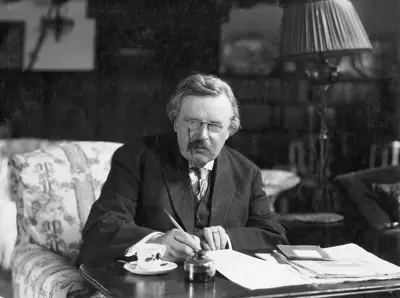
Gilbert Keith Chesterton KC*SG was an English writer, philosopher, lay theologian, and literary and art critic. He has been referred to as the "prince of paradox". Time magazine observed of his writing style: "Whenever possible Chesterton made his points with popular sayings, proverbs, allegories—first carefully turning them inside out."
