George M. Whitesides Quotes
Part of science is the questioning of authority, absolute freedom of ideology. The Soviets did some very good science, but when science ran into ideology, it had trouble. Science flourishes best in a democracy.
Kruglinski, Susan. "The Discover Interview: George Whitesides." Discover, Kalmbach Publishing, Dec. 2008.


The Scientific Project that developed the Atomic Bomb. Oppenheimer was the great physicist who directed the successful development of the atomic bomb so as to build the weapon before Hitler did in World War II. However, as the technology evolved, he had doubts as to the wisdom of creating even more powerful hydrogen weapons. His viewpoint was hurting the administration’s policy of rapid unlimited nuclear weapons development, and he was the victim of a character assassination whereby his security clearance was withdrawn. The “father” of the atomic bomb was the first American casualty of atomic weapons development.


On a much smaller and less damaging scale, there were some government American officials tried to intimidate, censor and if thosoe failed, ruin and discredit scientiosts who did not agree with their view of the dangers of nuclear weapons and the various policy options. Although they drove Oppenheimer and some other scientists out of government and to this day have produced scientists who will not work on government research, the laws, Constitution and checks and galances and cmittment to the Constitution be most Americcans limited the damage somewhat and unlike Russia who assassianted scientists who did not follow the Party line, the few American officials just asassinated their character and patriotism.

In many nations, including the United States on occasion, governments have made laws as to what is valid science and what is not. Tennessee and other Bible-Belt States have and still do on occasion. The latest being Evolution, which even in the beginning of the 21st century, Kansas determined that it was not proven science, when it is as proven as any science has ever gotten.

Gross and the Nazi official party line completely rejected what some called “Jewish Science” the new world of Theoretical Physics that had grown out of Einstein’s early 20th century work. Although Einstein and most of the great German physicists fled Germany for America, England and Scandinavia, there were Heisenberg and enough left that Germany was probably capable of development of an atomic weapon. But since such a weapon would have been based on politically unacceptable “Jewish science,” no one would dare suggest it seriously. Ironically, Gross actually thought that The Theory of Relativity was only a theory which by that time, it was not and had been validated by physicists the world over—including Germany. The German scientists were directed at traditional German technology to develop jet airplanes and long range rockets, both of which they developed successfully. It was however too late to make a difference, and if these weapons were strong enough to defend Germany from invasion, the first Atomic bombs would have been dropped on Germany as that was the plan and the major purpose of development. Only the collapse of Germany under the allied attacks, moved the target from Germany to Japan.


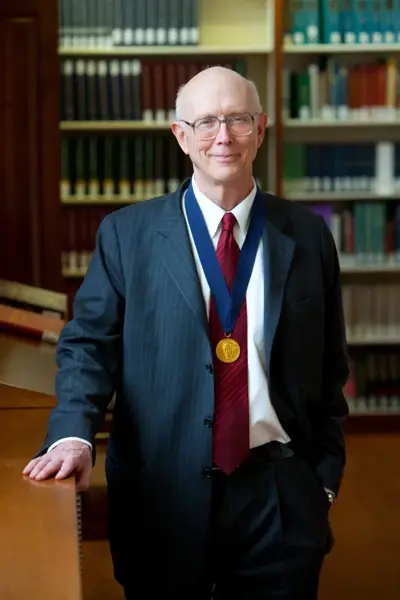
George McClelland Whitesides is an American chemist and professor of chemistry at Harvard University. He is best known for his work in the areas of nuclear magnetic resonance spectroscopy, organometallic chemistry, molecular self-assembly, soft lithography, microfabrication, microfluidics, and nanotechnology. A prolific author and patent holder who has received many awards, he received the highest Hirsch index rating of all living chemists in 2011.
