Robert Alexis McClure Quotes
Our propaganda did a lot to break the Wops --- as their emissaries admit --- now we have to turn it on the Germans
Robert Alexis McClure, 1897-1957, General & Developer of Psychological Warfare, WWII Letter to his wife
Sourced by: Eigen's Political and Historical Quotations

Von Richthofen, cousin of the “Red Baron,” was justifying tactics that the Germans tried out in Spain before the Second World War—specifically the complete obliteration of Guernica by bombing and strafing although there were no military targets in the city. Guernica was the first city ever completely destroyed by aerial bombardment. The atrocity inspired Picasso’s great paining of that name.


The smaller German towns had not been targets for allied bombing and German censorship kept most Germans from realizing that the factories in the larger cities were being attacked. But the “rules of war” which the Germans had abandoned early in the war by bombing civilian targets in England and other European cities, required that only military targets be attacked. If a nation placed its factories or military bases in the midst of civilian populations, then the rules of war no longer protected the civilians. So the allies were within their rights by bombing the smaller towns where they targeted factories. However, this quotation is used by some critics to show that FDR’s motive was not the destruction of factories per se, but the breaking of German civilian morale. They argue that the allies were following the letter of the law, but not the spirit.

This has been true in just about every conflict. In WWII however, there were a highly disproportionate ration of atrocities with those of the axis forces dwarfing those of the U. S. and its allies. Further, after the war, those allied atrocities that did take place were published. In addition, one basic difference is in the policies of the fighting forces and their governments as opposed to individual actions by soldiers. In WWII, the allied atrocities were of the latter type, but the axis atrocities involved both.

Jacobo Arbenz, 1915-1971, was the President of Guatemala who the Central Intelligence Agency ousted by organizing a coup and providing a CIA airplane to terrify and intimidate Arbenz’s loyal soldiers. Guatemala had never been bombed before and the low flying planes had the desired effect. This quotation is important because it shows that the United States engaged in some terrorism and some officials actually used the term “terror” in describing one of our activities.


“Lord Haw Haw” was the name that he used in his propaganda broadcasts from Germany to England. Despite the fact that the broadcasts were anti-British and pro German, many in Britain listened to him regularly. He was very witty and many of his criticisms of British society were views held by many patriots in Britain. As pure entertainment, he was better than most of the BBC broadcasts during WWII. At the end of the war, Joyce was captured, tried and executed for treason.
The Radical Religious Right in America did not have its origins as a reaction to the 1960s as some believe. It was present among the Know Nothings in the 19th Century, the KKK in the aftermath of Reconstruction, and during the Second World War.

This quotation shows how large the American Post WWII German Propaganda Effort was. See {589369} for an earlier description.
After the Germans surrendered, the Army ran a huge propaganda enterprise. See {589368} to learn how it expanded.

This is the earliest known explicit writing about physiological warefare and its effect on morale of the enemy.


The Americans had attacked the Belgian city of Brest and had been repulsed by a well fortified and led German contingent. Analysis of the wartime situation showed that Brest, a port city was no longer necessary for the Allied supplies as numerous other ports were taken and were available. Many of the officers wondered why Bradley wanted them to attack and defeat the Germans in Brest when all they had to do was surround them and eventually starve them out. Bradley’s response explained a subtle aspect of military and foreign policy. It is that the United States Army, once committed, will never be defeated or stopped. Had the Americans not already attempted to take Brest, they would not have bothered at this stage of the war, but since they had, it was imperative that they succeed. Otherwise, it was felt that Allies and enemies would not take future American threats as seriously and that the morale of American soldiers would even be affected if they thought they could be beaten. A similar problem occurred in the Vietnam War and later in the Iraq war. Once the short term military necessity of fighting was gone, the long-term factors came into play and often will. Others argue that the United States military is so strong and well equipped, that it no longer necessary to take casualties just to prove a psychological point.

Neilson had flown in the Doolittle Raid on Tokyo. It was the first bombing of Tokyo in WWII. He was shot down and captured. He was tortured including the torture of ‘waterboarding.’ The Japanese who administered the torture and who allowed it were tried before the International Military Tribunal for the Far East—the Tokyo War Crime Trials. They were convicted and punished. In the first decade of the 21st century the George W, Bush Administration argued that waterboarding was not necessarily torture despite the fact that Americans had tried and punished foreigners who engaged in the practice and even Americans who did. It was completely outlawed by military regulations but some Americans felt that it should be allowed by the CIA in dealing with terrorists.

This referred to ships being torpedoed by the German U-Boats in the poster.

The Ayatollah reverses logic. Iranian feminists protest not because America tells them to but because Iran is terribly discriminatory and cruel to women. Students are dissatisfied because they have been trained as professionals and the government policies do not encourage the kind of economic growth that would be able to employ them.
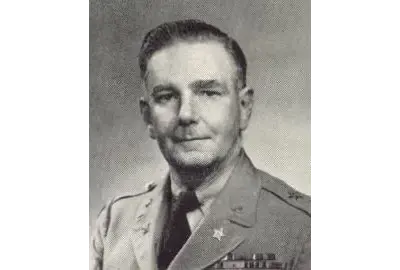
Robert Alexis McClure was an American general and psychological warfare specialist, who is considered as a Father of U.S. Army Special Warfare.
