Martin Van Buren Quotes
Our country presents on every side the evidences of that continued favor under whose auspices it, has gradually risen from a few feeble and dependent colonies to a prosperous and powerful confederacy.
Van Buren, Martin. "Inaugural Address." The American Presidency Project, edited by Gerhard Peters and John T. Woolley, 4 Mar. 1837.


In one of the most unusual revolutions in world history, Brazil became independent from Portugal via a revolution led by the son of the Portuguese King and heir to the throne, Pedro I. The crown prince of Portugal, led Brazil in her breakaway from Portugal and by popular acclaim became Pedro I, Emperor of Brazil. He is probably the only monarch in history who was the heredity monarch of one kingdom and selected by popular acclaim to the throne of another.


In that year Republican President William McKinley reversed Cleveland’s policy against expansionism at the expense of independent peoples. He staved off annexation while he was president because of his views as early as 1893. See {643147}.


Ultranationalist Secret Organization. Unlike the Italian Black hand for whom it was named, the Serbs were not interested in money. The were a right wing death squad that assassinated all who opposed a single, unitary, Serbian nation. Dimitrijevic was executed in 1917.


East Pakistan—now Bengladesh—revolted and declared independence. The military cracked down committing atrocities against the rebels who asked India’s help. India intervened and Pakistan declared war on India and then suffered a humiliating defeat. Pakistan was isolated and distraught when Bhutto tried to rally the nation. What was fascinating, that there was very little damage to the non-military infrastructure of Pakistan. Their military bases and many of their major weapons systems and warplanes were destroyed, but in terms of the economy Pakistan was not in any crisis at all. However, Pakistan was and still is a militarily controlled nation where the president and prime minister, when civilians, have little significant power. The Pakistani people have been brainwashed by successive military leaders to believing that they were a superior military power and many of the religious leaders preached that their Islamic faith had to be protected from the Hindu Indians by strength of arms. The crisis was one of confidence and the only reason there was any economic consequence was that Pakistan would use immense sums of public revenue to not only rearm but also develop a nuclear capacity. This was the crisis—Pakistan would be poor for years because of military spending, See {623844} . The loss of East Pakistan (Bangladesh) actually made Pakistan much richer, The per capita earnings of East Pakistan was much lower, and East Pakistan was the most expensive part of the country to support (not counting military expenditures.) Ironically, with a military government paranoid about India with more control and more money, Muslims living in India had more freedom and were economically better off than the Muslims of Pakistan.

On the need to build up Jewish military strength in anticipation of the impending Arab-Israel crisis


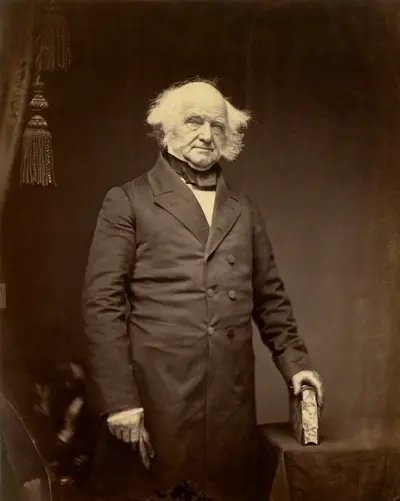
Martin Van Buren was an American lawyer and statesman who served as the eighth president of the United States from 1837 to 1841. A founder of the Democratic Party, he had previously served as the ninth governor of New York, the tenth United States secretary of state, and the seventh vice president of the United States. He won the 1836 presidential election with the endorsement of popular outgoing President Andrew Jackson and the organizational strength of the Democratic Party. He lost his 1840 reelection bid to the Whig nominee, William Henry Harrison, thanks in part to the poor economic conditions surrounding the Panic of 1837. Later in his life, Van Buren emerged as an elder statesman and an important anti-slavery leader who led the Free Soil Party ticket in the 1848 presidential election.
