Vitruvius Quotes
Our ancestors, when about to build a town or an army post, sacrificed some of the cattle that were wont to feed on the site proposed and examined their livers. If the livers of the first victims were dark-coloured or abnormal, they sacrificed others, to see whether the fault was due to disease or their food. They never began to build defensive works in a place until after they had made many such trials and satisfied themselves that good water and food had made the liver sound and firm, healthfulness being their chief object.
Vitruvius. Vitruvius: The Ten Books on Architecture. Translated by Morris Hicky Morgan, Harvard University Press, 1914, p. 19.

This quotation shows us that even before the birth of Christ, amongst the elite intellectuals of the Roman society, empiricism, experiment and the scientific method were commonly utilized. The Dark Ages and the Domination of the Roman Catholic Church saw this type of thinking disappear, though books such as these survived and with the birth of Islam were preserved and used by the Muslims until the found their way back to Europe in the 16th century.


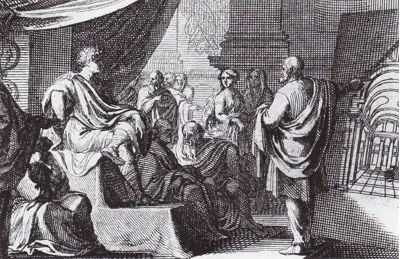
Marcus Vitruvius Pollio (/vɪˈtruːviəs ˈpɒlioʊ/; c. 80–70 BC – after c. 15 BC), commonly known as Vitruvius, was a Roman author, architect, and civil and military engineer during the 1st century BC, known for his multi-volume work entitled De architectura. He originated the idea that all buildings should have three attributes: firmitas, utilitas, and venustas ("strength", "utility", and "beauty"). These principles were later widely adopted in Roman architecture. His discussion of perfect proportion in architecture and the human body led to the famous Renaissance drawing of the Vitruvian Man by Leonardo da Vinci.
