Vitruvius Quotes
Our ancestor when choosing a site to build a fort of a town would always sacrifice a number of cattle to have them doing the water and eat the grass. Then they would kill them and examine their livers. If these were dark or abnormal, they would sacrifice others to be sure that the first were not just diseased. They never built until the made many such trials to be sure that the water and food was heathy for the animals. For if the continued to obtain abnormal livers, they reasoned that this place would be just as unhealthy for man and moved to another site.
This quotation shows us that even before the birth of Christ, amongst the elite intellectuals of the Roman society, empiricism, experiment and the scientific method were commonly utilized. The Dark Ages and the Domination of the Roman Catholic Church saw this type of thinking disappear, though books such as these survived and with the birth of Islam were preserved and used by the Muslims until the found their way back to Europe in the 16th century.
Vitruvius Book I The Ten Books on Architecture
Sourced by: Eigen's Political and Historical Quotations


Flaccus


Allen observed that atheists and irreligious people rarely believe in witchcraft. Even in free America, Allen had a very difficult time getting this work printed because it was so controversial culturally.


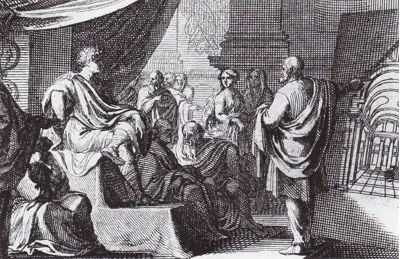
Marcus Vitruvius Pollio (/vɪˈtruːviəs ˈpɒlioʊ/; c. 80–70 BC – after c. 15 BC), commonly known as Vitruvius, was a Roman author, architect, and civil and military engineer during the 1st century BC, known for his multi-volume work entitled De architectura. He originated the idea that all buildings should have three attributes: firmitas, utilitas, and venustas ("strength", "utility", and "beauty"). These principles were later widely adopted in Roman architecture. His discussion of perfect proportion in architecture and the human body led to the famous Renaissance drawing of the Vitruvian Man by Leonardo da Vinci.
